A coat tree is not a morning.
Homes & Gardens’ September 27 entryway piece is a shopping column with a useful sentence buried under Amazon cards: extra hooks help, dedicated drop zones for each person work. Bags, shoes, and the junk that otherwise lands on the nearest chair get a named home. Fall is when that chair becomes a coat pile because the weather finally asks you to carry things.
We already did small-space shoe storage and generic entryway ideas. Those were layouts. This week is a product class with a Japanese name on the box and a 2027 trend piece that wants your bins to be entertaining. Keep the layout. Stop buying a fourth hook rail because the first three still dump onto the floor.
The drop zone is a person, not a wall
The Homes & Gardens line that matters is not “Japanese-inspired.” It is one station per person. School bag, shoes, keys, the thing you always lose on the way out. If four people share eight hooks, you have a fight, not a system. A fight looks like organization until 7:40 a.m.
A genkan in a Japanese house is a level change and a rule: shoes stop there. Most U.S. rentals do not give you a level change. They give you a 36-inch hall and a landlord who will cite the fire code if you park a rack in the path. The imported object has to do the rule without the architecture.
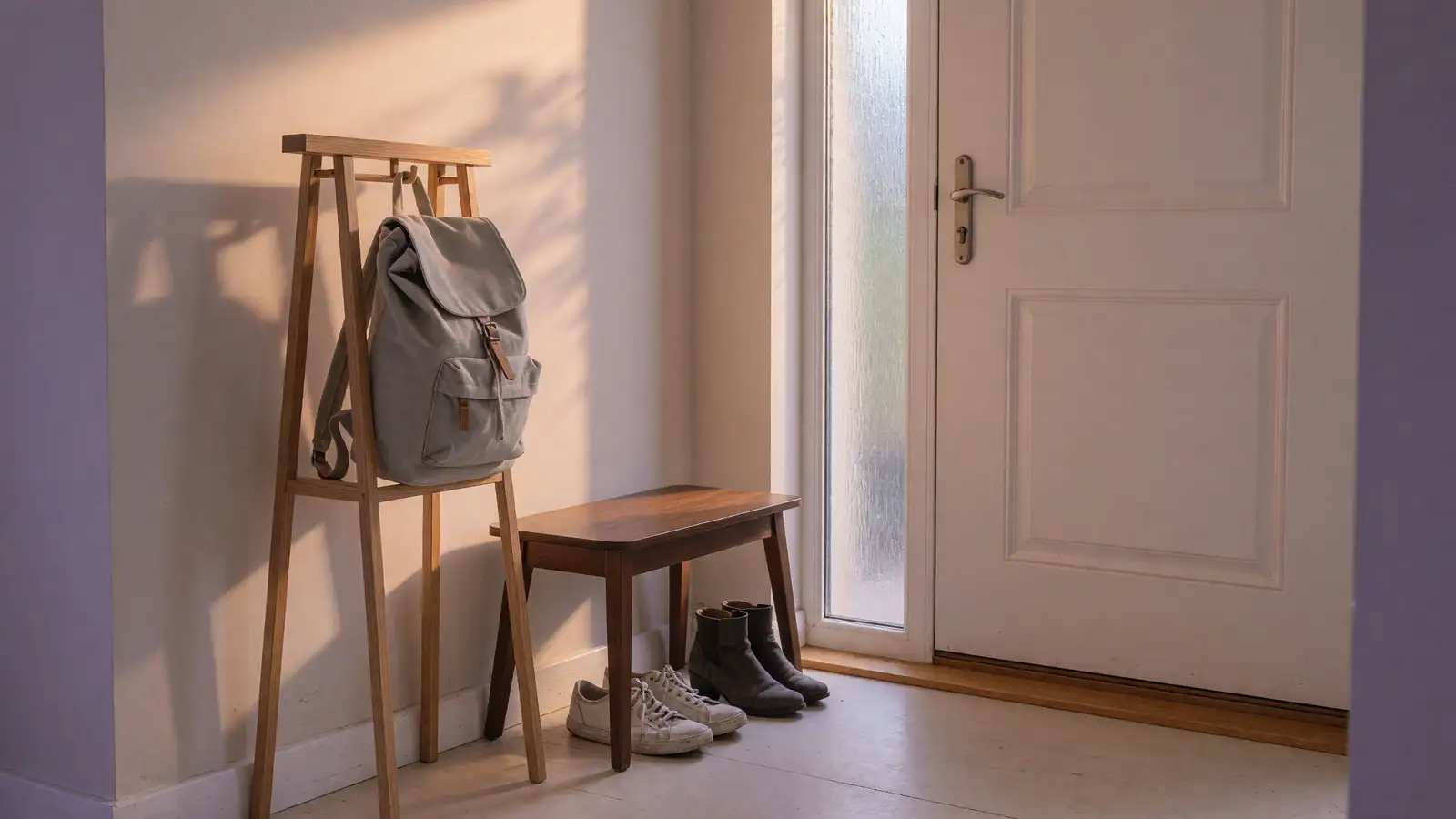
That is why a freestanding backpack stand shows up in a fall roundup. It is not prettier than a built-in. It is a rectangle you can assign. Name it. “This is Maya’s. This is yours.” If you cannot point at a rectangle, you do not have a drop zone. You have hope.
The same article admits baskets and extra hooks are the usual first move. They are also how you postpone the assignment. A basket that belongs to “the family” belongs to no one. It fills. You buy a lid. You still step over shoes.
If you already built a mudroom that actually functions, you have the luxury of cubbies. Most people reading a September shopping column do not. They have a door, a radiator, and a week before the coats get heavy. Assign floor and vertical space in that order. Floor for shoes. Vertical for bags. The chair in the living room is not a third category.
The Yamazaki stand is a station with a receipt
Homes & Gardens points at the YAMAZAKI Home Tower Home Backpack Stand on Amazon as the object that makes the per-person idea concrete: backpacks, accessories, and shoes in one freestanding tower so the rest of the entryway can stop being a loading dock. I am not selling you that SKU. I am noting what the editor needed it to do. One object’s job is “this kid’s stuff lives here.” If your stand does that for $40 less from a no-name brand, it is the same job.
What it is not: a closet. It will not eat winter boots, the vacuum, and the recycling. If you treat a backpack tower like a mudroom, you will hate it by Thanksgiving. Put the off-season elsewhere. We already argued that a storage unit is not a declutter. An entryway tower is not a storage unit either.
Measure the hall before you click. Freestanding only works if a person can still walk past with a grocery bag. If the tower eats the path, you bought a fire-code problem and called it Japanese. The Yahoo shoe piece this week, more on that below, is the same physics from the other direction.
If you live alone, you still need a station. Solo households turn the dining chair into the backpack stand. That is a drop zone with worse furniture. One small tower or one wall of hooks plus a tray is enough. The point is the assignment, not the brand.
Families should resist the matching-set upsell unless everyone actually has the same stuff. A kindergartener’s backpack and an adult laptop bag do not want the same hook height. One adult station can be a tray and two hooks. Kids get the tower because they will not hang anything that requires a decision.
A rotating coat tree is vertical. A bench is a seat you will pile
The same Homes & Gardens shop list is honest about the other shapes.
The Muwuele rotary coat rack is three shelves and nine hooks on a turning column. Vertical storage, small footprint, you spin to the coat you want. That is a good object if coats are the actual problem. It is a bad object if shoes are the problem. Hooks do not store sneakers. People who buy a coat tree to “fix the entryway” still have a shoe pile. They just have a nicer pole in the photo.
The Aqimuele shoe bench with a coat rack tries to do both. The write-up: seven hooks for bags, coats, umbrellas; two shoe tiers; the 24.4-inch version holds four pairs. Four pairs is one person’s weekday rotation, or two people who own almost nothing. It is not a family of four in October. Read the pair count like a capacity rating, not like a vibe.
A bench also becomes a landing pad. Mail, backpack, Amazon box. If you buy a bench, you are buying a horizontal surface that will attract everything you refused to assign. Either accept that and empty it every night, or skip the bench and keep the surface area tiny on purpose.
StorageWorks fabric bins with lids showed up as the seasonal extra: collapsible, park them on a shelf when guests leave. That is the right use of a bin. Guest season and sports gear. Not “a bin for the entryway” as a personality. Lids hide mess. They do not create a drop zone. If you need a lid in the first three feet of the house, the station failed.
Shop the shape that matches the object that currently hits the floor. Coats on a chair: vertical hooks or a tree. Shoes in a heap: tiers or an angled rack, counted in pairs. Bags on the newel post: a backpack stand. All three: you need more than one object, or a real mudroom, not a combo bench that pretends to be a renovation.
2027 wants storage to be a treat
Homes & Gardens’ September 25 storage-trends piece for 2027 is a style editor’s forecast. Devin Toolen, quoting an organizer named Genna, pushes “dopamine storage”: a yellow cabinet for board games, playful wall hooks, objects that feel as good as they function. When storage is nice to look at, people use it more. That is the claim.
Sometimes that is true. A hideous over-the-door rack is easy to ignore until it falls. A hook you like is a hook you use. I will not pretend a yellow cabinet organizes a family that never assigned cubbies. Color is not a drop zone.
The useful part of the trend piece is smaller. Baskets are not new, and they are not only for living-room blankets. Kitchen, dining, bath, bedroom, entryway. Texture, organic material, a place for the thing that has no drawer. That is old advice. It is still how you keep a drop zone from looking like a locker room if you refuse built-ins.
Custom millwork is “inherently personal,” the same article says. Store-bought can mimic it if you work harder. Translation: IKEA plus a paint color is not a carpenter. It can still be a named station. Paint the backpack stand if you must. Do not delay the station until you can afford millwork. Fall will not wait.
Dopamine storage is a 2027 mood board. Fall 2026 is wet leaves in the hall. If you have budget for one pretty object, put it where your hand already goes: the hook you actually use, the tray that already holds keys. Do not start with a statement cabinet for board games while the backpack lives on the floor. Games can wait in a closet that closes.
If you already like warm minimalism, you do not need a yellow cabinet to prove you have a personality. You need the floor back.
The hallway still has a fire code
Yahoo Shopping’s September 25 shoe-organization column is a different economic class of problem. A reader hates shoes in the entryway. The rack eats the path. Closet hangers between bedroom and living room look ugly. Landlords and the fire code ban leaving shoes in the hall outside the door.
The suggested fix is not a bigger rack. It is geometry: store shoes on an angle to shrink the footprint. That is the whole useful paragraph. An angled rack is still a rack. It is a narrower rack. In a code-sensitive building, narrower is the product.
If your building will not let shoes live in the public hall, stop arguing with the super in your head. The drop zone moves inside the door, and it has to stay walkable. That is why the Yamazaki tower only works if you can pass it. That is why four-pair benches fail a household of six.
The same Yahoo piece wanders into a Hollinger Metal Edge preservation kit for fancy shoes: acid-free tissue, cotton gloves, a clear lid. That is museum storage. It is not an entryway. If you own shoes that need a preservation kit, they do not belong in the drop zone. They belong in a closet that does not see rain. Mixing heirloom leather with school sneakers is how both get ruined.
Angle the daily pairs. Box the rare pairs. Do not buy a hallway-width rack and then act shocked when someone cites fire code. The code is not an organizing opinion. It is the reason your “temporary” shoe row cannot live where you wanted it.
Renters get one more constraint the shopping columns skip: you may not drill. Freestanding towers, tension rods, and angled racks exist because of that. If you can drill, a rail at two heights still beats a tree that walks when you pull a coat. If you cannot drill, measure twice. The Amazon return is not a storage system.
What to skip this week
Skip a fourth set of matching hooks because the first three are already full. Full hooks mean you have more coats than stations, or you never assigned stations. Buy assignment. Or donate a coat. The 90/90 rule still applies to the denim jacket nobody has worn since April.
Skip “dopamine” as a shopping filter. If a yellow cabinet makes you put the games away, fine. If you are buying color to postpone counting shoe pairs, you are decorating a pile.
Skip combo furniture that claims seven hooks and four pairs will replace a mudroom. Read the pair count. Count your household’s Tuesday shoes. Tuesday is the test, not the weekend party.
Skip outdoor hallway storage if your lease or fire code already said no. The Yahoo letter-writer already lost that argument. Bring the rack inside and make it skinny.
Skip a preservation kit for sneakers. That product is for shoes you do not wear in rain. The drop zone is for shoes you wear in rain. Different objects. Different rooms.
What to do instead, in one weekend: pick a rectangle per person. Put shoes on an angle or on two tiers, counted in pairs, not in “vibes.” Put bags on a tower or on hooks at the right height. Put a tray for keys on the first surface that is not a bench you will pile. Take a photo. If you cannot see floor, you are not done.
Fall will add a coat. The coat needs a hook that is not already doing three jobs. If every hook is already doing three jobs, you do not have an entryway problem. You have a closet that never got edited, and a shopping column cannot edit it for you.
The Japanese label on this week’s stand is marketing. The per-person rectangle is the method. Buy the method. Leave the mood board for 2027.