The bathroom is the smallest room in most homes, yet it has to hold more categories of stuff than almost any other space. Skincare, makeup, medications, towels, cleaning supplies, toilet paper — it all competes for the same few square feet.
This year’s Best of Houzz award winners and the professional organizers we spoke to all agree on one thing: bathroom storage isn’t about having more space. It’s about using every inch you already have more intelligently.
1. Go Floor-to-Ceiling
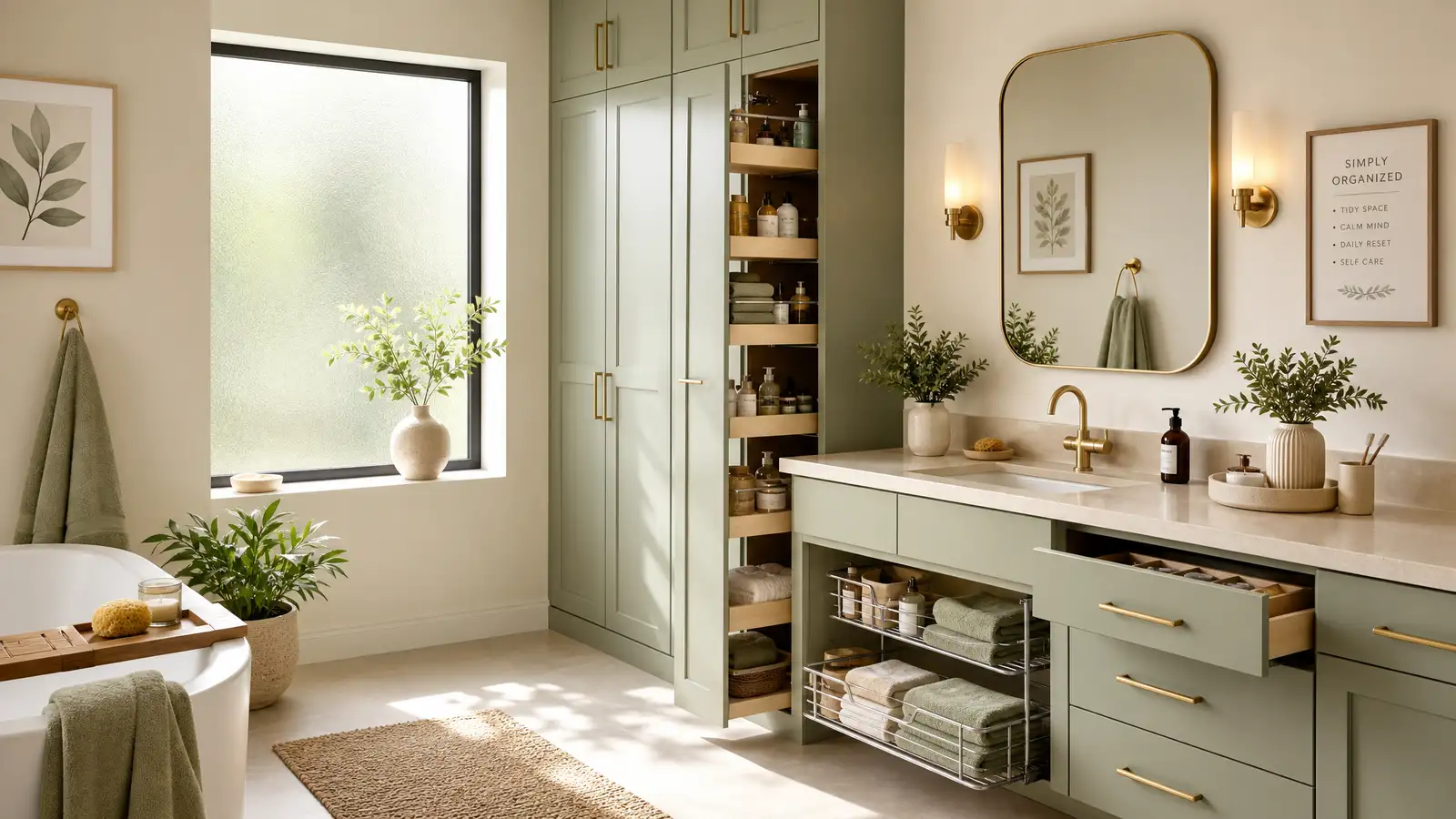
The space above your toilet and the empty wall between your vanity and the ceiling is free real estate. A floor-to-ceiling cabinet or set of open shelves adds storage you didn’t know you had.
Built-in shelving is ideal, but a tall freestanding cabinet designed for bathroom humidity works nearly as well. Store everyday items on the middle shelves, less-used products up high, and cleaning supplies or spare toilet paper in closed lower cabinets.
2. Add a Countertop Tower
If your vanity has empty counter space at one end, a tiered countertop tower is the simplest upgrade you’ll make this year. These vertical organizers — usually two or three levels — hold skincare bottles, toothbrush holders, and daily essentials without sacrificing counter space.
The key is picking one that matches your vanity width and doesn’t overhang. Measure before you buy. A tower that fits flush transforms a cluttered counter into something that looks intentional.
3. Pull-Out Shelving Changes Everything
Deep lower cabinets are storage black holes. Things get pushed to the back and disappear forever. Pull-out shelves — either built-in or aftermarket slide-out units — let you access everything in the back without kneeling on the floor with a flashlight.
Install them under the sink for cleaning supplies, in a tall cabinet for hair tools, or in a vanity drawer for makeup. The motion is smooth, the visibility is instant, and you’ll wonder why every cabinet doesn’t work this way.
4. Wire Baskets Under the Sink
The space under a bathroom sink is awkward. Pipes run through the middle, the walls are curved, and nothing stacks neatly. Wire baskets solve all three problems. They’re open enough to see what’s inside, they slide out easily, and they come in enough shapes to work around plumbing.
Group items by category — one basket for extra soap and shampoo, one for cleaning products, one for backup toiletries. When guests are coming over, you pull out the cleaning basket instead of digging through a pile of bottles.
5. Over-the-Toilet Shelving
The wall above the toilet is the most underutilized surface in any bathroom. A simple over-the-toilet shelf unit — either freestanding or wall-mounted — gives you two or three extra shelves without taking up any floor space beyond what the toilet already occupies.
Use the bottom shelf for spare toilet paper (visible and accessible), the middle for folded towels, and the top for decorative items — a small plant, a candle, or a glass jar of bath salts. It turns a purely functional area into part of the room’s design.
6. Maximize Vanity Length
If you’re renovating or building, extend the vanity to fill the entire wall. A longer vanity means more counter space, more drawers, and more under-cabinet storage — often for a marginal increase in cost compared to a standard-width unit.
Even in an existing bathroom, you can add a narrow rolling cart or a slim cabinet next to the vanity to capture that dead zone between the vanity and the wall.
7. Drawer Dividers Are Non-Negotiable
A bathroom drawer without dividers is a junk drawer, and bathroom items are too small and too numerous to share space gracefully. Adjustable drawer dividers let you create custom compartments for everything: one section for cotton swabs, another for hair ties, a long one for combs and brushes.
The rule of thumb from professional organizers: nothing in a bathroom drawer should roll, slide, or tangle. If it does, it needs its own compartment.
8. Over-the-Door Storage
The back of the bathroom door is prime storage real estate that costs nothing to use. An over-the-door rack with multiple tiers holds towels, robes, or even a hanging organizer with clear pockets for smaller items.
Clear pocket organizers work especially well for family bathrooms — each person gets a row for their toothbrush, hairbrush, and personal items. Labels optional, strongly recommended.
9. Open Shelving for Daily Items
Closed cabinets are for the things you don’t want to see. Open shelving is for the things you use every day and want to reach without opening a door. A single open shelf at eye level — holding a neatly folded towel stack, a small tray of skincare essentials, and one decorative object — makes the bathroom feel like a hotel.
The catch: open shelving only works when you commit to keeping it uncluttered. Limit each shelf to three categories of items, maximum.
10. Start With a Declutter
Every storage solution works better after a declutter. Pull everything out of your cabinets and drawers, check expiration dates, and be honest about what you actually use. That half-empty bottle of shampoo you bought on vacation three years ago? Let it go.
Once you see how much space you actually need — not how much stuff you’ve accumulated — the storage solution becomes obvious. The best organizers are the ones you don’t have to fill.