The most organized person I know keeps her mail in a wicker basket on the kitchen counter. She doesn’t sort it daily. She doesn’t have a color-coded filing system. The basket just sits there, absorbing the daily avalanche of envelopes and catalogs, and about once a week she empties it. That’s the whole system.
I used to think organization meant the Instagram version: matching glass jars, label makers, drawers subdivided into smaller and smaller compartments. But systems that depend on daily discipline are systems designed to fail. They work on Tuesday when you’re motivated and everything gets put away at a satisfying right angle. They collapse on Thursday when you’re tired and the mail goes on the counter and stays there for four days.
There’s a name emerging for a different approach. Jolie Kerr, writing in The Washington Post on July 18, calls it “soft decluttering” — a gentler way of dealing with stuff that treats perfection paralysis as the real enemy, not the mess itself. The core idea is that organizing strategies need to survive your bad days, not just showcase your good ones. Kerr points out that even highly motivated people hit a wall when faced with large-scale organizing projects, because the mental image of “getting organized” has become synonymous with “completely overhauling everything.”
The friction problem that kills most storage systems
Every storage decision adds or removes friction. A lid adds friction. A drawer that requires two hands adds friction. A bin that has to be pulled off a high shelf with a step stool adds enough friction that you’ll probably just leave the thing on the floor. Multiply this by every item in your home and you start to see why some rooms stay organized while others don’t — it’s rarely a personality flaw, it’s a friction imbalance.
Open bins are faster than lidded boxes. Hooks are faster than hangers. A shelf at eye level is faster than one above your head. These micro-decisions compound: a system with five friction points per item becomes a system you use exactly twice before abandoning it for the nearest flat surface.
Faith Roberson, a professional organizer and author of What Stays and What Goes, recommends thinking about storage as “frequency zones.” Items you reach for daily belong at waist-to-eye level, in open containers. Items you use weekly can go behind a cabinet door. Seasonal items — the holiday decorations, the winter boots — earn their place in the high shelves and deep closets where the friction is acceptable because you only deal with them twice a year.
The trap is giving everything the same treatment. They buy matching bins with snap-tight lids for the pantry, the bathroom, the entryway — and then wonder why the lids are always off and the bins are half-empty with stuff piled on top. The lids didn’t fail. The assumption that everyone in the household would consistently close them did.
A better approach is to audit your own friction tolerance honestly. If you know you won’t put lids back on, don’t buy lidded containers. If you know you won’t fold sweaters into neat stacks, install shelves deep enough for a pile. Design around the real person, not the aspirational one.
Zone-based storage that bends instead of breaking
The “zone” concept shows up in refrigerator organization guides and pantry systems, but it applies to any space where multiple activities overlap. A forgiving zone doesn’t demand precision — it just asks that items land somewhere in the right general area.
A functional entryway zone might be: a wall hook for the bag you carry every day, a shallow tray on a console table for keys and sunglasses, a basket on the floor for shoes that don’t need to be in the closet. None of these are sorted. None are labeled. But everything has a place that takes less than two seconds to use, and when you walk in tired at the end of the day, your stuff goes somewhere that isn’t just “wherever you dropped it.”
The NPR piece on small-space design tricks from July 19 points out something related: too many small, precisely-organized containers in a room create what designer Betsy Lynch calls a “dollhouse effect” — visual clutter that actually makes a space feel smaller. A few larger, looser containers read as calmer and more intentional than a grid of tiny compartments, even if the tiny compartments technically hold more. Lynch recommends choosing furniture scaled to your actual room size: a table for four in a small dining room, not a squeezed-in table for six with no walking space around it.
This runs counter to a lot of organizing advice. The Container Store wants you to believe the solution is always more subdivision. Sometimes the solution is fewer, bigger buckets with lower standards for what goes inside them.
In practice, this means that a bathroom counter with one wide tray containing your daily-use items looks better and functions better than five separate organizers fighting for surface space. The tray has one job: corral things into a defined area. Whether the items inside are perfectly arranged is irrelevant — they’re inside the zone.
Vertical storage isn’t just for small apartments
The NPR article focuses on floor-to-ceiling shelving as a small-space trick — drawing the eye upward to create the illusion of height while adding storage with minimal square footage. But the principle works at any scale. Wall-mounted storage gets things off horizontal surfaces, which are the first places clutter accumulates.
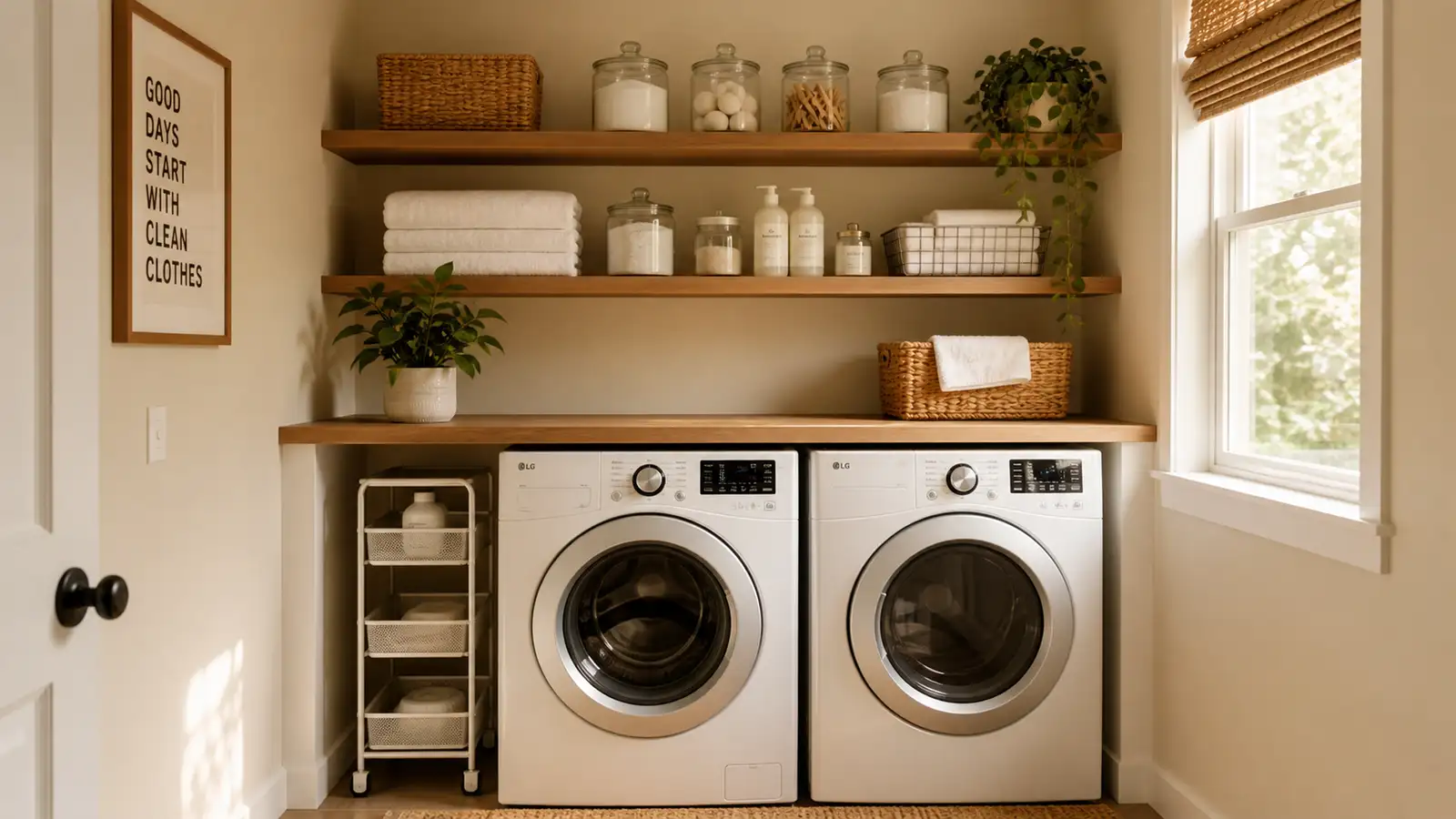
Floating shelves in a bathroom keep counters clear without demanding cabinet Tetris. Pegboard in a garage or utility closet turns wall space into tool storage that’s visible at a glance — no more digging through drawers for the screwdriver you know you own. Even a row of hooks inside a closet door handles robes, bags, and tomorrow’s outfit in a way that a hanger never will, because a hook requires one motion and no fine motor skills.
Roberson emphasizes that this works because vertical storage trades floor space — which is scarce — for wall space, which is abundant and usually wasted. A floor-to-ceiling bookcase in a living room might take up four square feet of floor but provide forty square feet of storage, which changes the math entirely for small homes.
The key variable isn’t square footage. It’s whether the storage matches the energy level of the person using it at their most depleted. A system that requires you to be at 80% to maintain it will stay maintained roughly never. A system that works at 30% will keep working indefinitely.
The few gadgets that actually earn their desk space
TechCrunch ran a desk gadgets roundup on July 21 that included items ranging from a $10 desktop vacuum to a $150 temperature-controlled coffee mug. Most desk gadget roundups are aspirational clutter — things you buy because you want to be the kind of person who uses them, not because they solve a real problem.
But one category earns its footprint: tools that prevent mess from accumulating in the first place. A miniature cordless vacuum that lives on your desk means crumbs and dust get dealt with in ten seconds instead of waiting for a weekly cleaning session that might not happen. At $13 from Odistar — currently discounted to $10 — it’s cheaper than most office organizing trays and does something those trays don’t: it removes a problem instead of just housing it.
An Echo Dot or similar voice assistant handles reminders, timers, and to-do lists without adding another screen to your field of vision. It also reduces the friction of transferring a thought to a system — saying “remind me to call the plumber at 9 a.m.” takes less energy than unlocking your phone, opening the reminders app, and typing the same thing.
The line between useful and clutter is whether the thing replaces a manual task you actually avoid. If you currently let crumbs sit on your keyboard for days because cleaning it properly requires finding the big vacuum and untangling the cord, the $10 desktop vacuum is good value. If you already wipe your desk down every evening, it’s just another object to store. The test is: does this gadget remove a step from a task I currently skip?
Maintenance routines that don’t need a routine
The most forgiving maintenance strategy is one that works without a schedule. Instead of “every Sunday I deep-clean the bathroom,” it’s “I keep cleaning wipes under every sink and use them when I notice something needs wiping.” The trigger is visual, not calendar-based.
This approach has a downside — it doesn’t produce the satisfying before-and-after of a scheduled cleaning session — but it prevents the catastrophic slide where missing two Sundays in a row means the bathroom doesn’t get cleaned for a month. Low-friction maintenance outlasts high-discipline maintenance every time.
The same logic applies to returning items to their homes. A storage system that’s forgiving doesn’t require you to “reset” the house at the end of the day. It absorbs the day’s entropy and lets you do a loose five-minute sweep instead of a forty-five-minute restoration project. The basket of mail on the counter isn’t a failure of organization — it’s a system that acknowledged reality and designed around it.
There’s a larger point Kerr makes in her soft decluttering framework that applies here: the goal is not a perfectly organized home. The goal is a home that functions well enough that you stop thinking about it and start living in it. Storage is infrastructure. Good infrastructure is invisible. You only notice it when it breaks.
The organizing industry sells you on the idea that the right product will finally make you the person who puts everything away. But the goal isn’t to become a different person. It’s to build storage that works for the person you already are — including the version of you that shows up at 9 p.m. on a Wednesday with no remaining executive function and a handful of things that need to go somewhere. That version of you deserves a system that doesn’t judge — and that system, it turns out, probably has fewer lids than you think, more hooks than drawers, and at least one basket that exists purely to absorb the chaos of daily life without complaint.