Minimalism is having another moment, but this time it looks nothing like the sterile white boxes that dominated Instagram five years ago. Designers across the industry are coalescing around a version of minimalism that keeps the discipline of “less” while adding something the old version never had: warmth. The all-white, personality-free interiors that became shorthand for the trend are being replaced by spaces with wood grain, texture you can feel, and objects that tell you something about who lives there.
The shift is showing up across the design press this week. House Beautiful’s autumn/winter 2026 trend report calls out a decisive move away from “pared-back interiors” toward spaces that feel “richer, warmer, and more layered.” Better Homes & Gardens ran a headline asking “Is Minimalism Back?” and the answer from the designers they interviewed is a qualified yes: it’s back, but it came back with the personality it lost the first time around. Homes & Gardens is even pointing to a 30-year-old celebrity home as a template for what they’re calling “warm wood minimalism.”
What’s driving this isn’t just a pendulum swing in taste. There’s a genuine exhaustion with interiors that look like they were generated by an algorithm, and a hunger for spaces that feel made by and for actual humans.
Where old minimalism went wrong
The version of minimalism most people encountered between roughly 2018 and 2023 wasn’t really minimalism. It was an aesthetic formula dressed up as a philosophy: white walls, empty surfaces, one sad succulent, furniture that looked like nobody had ever sat on it. The idea was clarity. The result was cold.
Meeshie Fahmy, founder and creative director of Haus of Meeshie, put it in unusually blunt terms when speaking to BHG this week. “Where I feel minimalism once represented refined restraint, it has now transformed to a cold lack of expression and more of a copy-and-paste design.” She described rooms with tonal paint, clean lines, and what she called a “nearly standoffish quality” — spaces that offered zero clues about the people who inhabited them.
Reesa Emadi, cofounder of Poppy Street Interiors, told the same publication that when homeowners adopt this style of minimalism, “the warmth and soul that come with a more expressive and personalized aesthetic get lost.” The problem wasn’t the philosophy of owning less. Our own Intentional Minimalism guide makes the case that being deliberate about what you keep is genuinely useful. The problem was the execution. Minimalism became a visual brand instead of a way of relating to your space, and the visual brand was designed to photograph well, not to live well.
The irony is that original minimalism — the kind architects and designers talked about decades ago — was never supposed to be cold. It was supposed to be honest. Materials were left exposed because they were beautiful, not because stripping them away was the point. Somewhere along the way, “honest” got replaced with “blank,” and the whole thing lost its soul.
What 2026 minimalism actually looks like
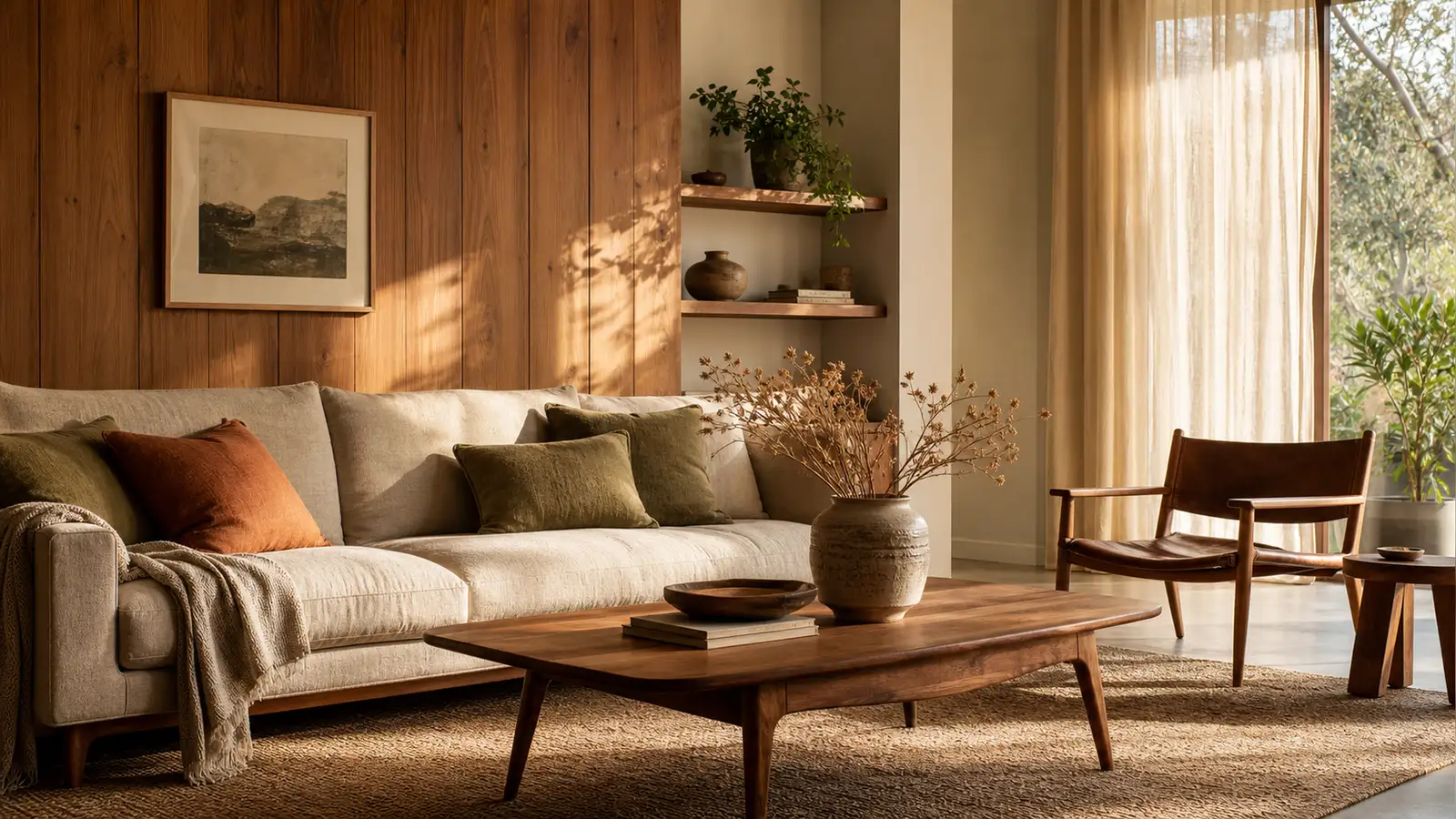
The new wave keeps the clarity but fills it with materials that feel human. Wood is the defining material of the moment. Not as an accent, but as a presence. Homes & Gardens recently revisited Jon Bon Jovi’s 1995 Malibu home and found it suddenly relevant again, pointing to its wood-paneled living room as a reference for what they’re calling “warm wood minimalism.” The paneling in that space serves a dual purpose: it softens the acoustics of a large room while adding visual warmth that painted drywall can’t produce.
Texture is doing the heavy lifting that pure color used to do. Limewash paint — a hand-applied finish with visible brush strokes, subtle tonal variation, and a chalky depth — is everywhere right now. Unlike flat matte paint, limewash changes depending on the light and angle. You can see the hand that applied it. Anna Ross, trends expert at Not On The High Street, told House Beautiful that this shift toward tactile, imperfect finishes reflects “a backlash to the AI fatigue we’re seeing.” When screens serve up flawless, frictionless imagery all day, people want their physical spaces to show evidence of human touch.
The furniture mix has changed too. The 2018 minimalist living room had matching pieces from the same collection. The 2026 version pairs eras intentionally. Emadi describes the ideal as rooms where “antiques sit beside contemporary pieces, and things do not match perfectly while belonging together.” That distinction between “curated” and “collected” runs through every designer interview. Curated implies a stylist arranging things for a photo. Collected implies someone lived with these objects long enough for them to accumulate meaning.
The color palette tells the same story. Cool grays and stark whites are out. In their place: earthy aubergines, tobacco browns, deep olive greens, and burnt terracottas. Kunal Trehan of Touched Interiors calls these “cocooning colours.” They’re tones that wrap a room rather than just covering its walls. A deep olive wall behind a simple wood dining table creates a sense of enclosure and warmth that the old white-box approach never could.
The practical shift: fewer things, more of what matters
Translating warm minimalism into an actual home doesn’t require a renovation budget. It’s mostly about adjusting the filter you use to decide what stays and what comes in.
Start with surfaces. If you’re repainting, skip the flat white and go for a warm neutral with some depth: a greige with brown undertones, or a single accent wall in deep olive or terracotta. The effect on a room’s feel is disproportionate to the effort. One wall in a saturated, earthy color can make an entire open-plan space feel grounded without adding a single object. If painting isn’t an option, textiles do parallel work. A wool throw in a burnt tone draped over a neutral sofa, or linen curtains in an undyed natural color, add warmth through texture rather than quantity.
Wood is the easiest material upgrade. You don’t need custom-milled hardwood panels. A wooden bowl on a coffee table, a solid wood picture frame, or a vintage teak side table all pull the same weight. The goal is to interrupt hard, reflective surfaces — glass, metal, polished stone — with something organic and matte. Even a single wooden object in an otherwise neutral room changes how the light feels in the space.
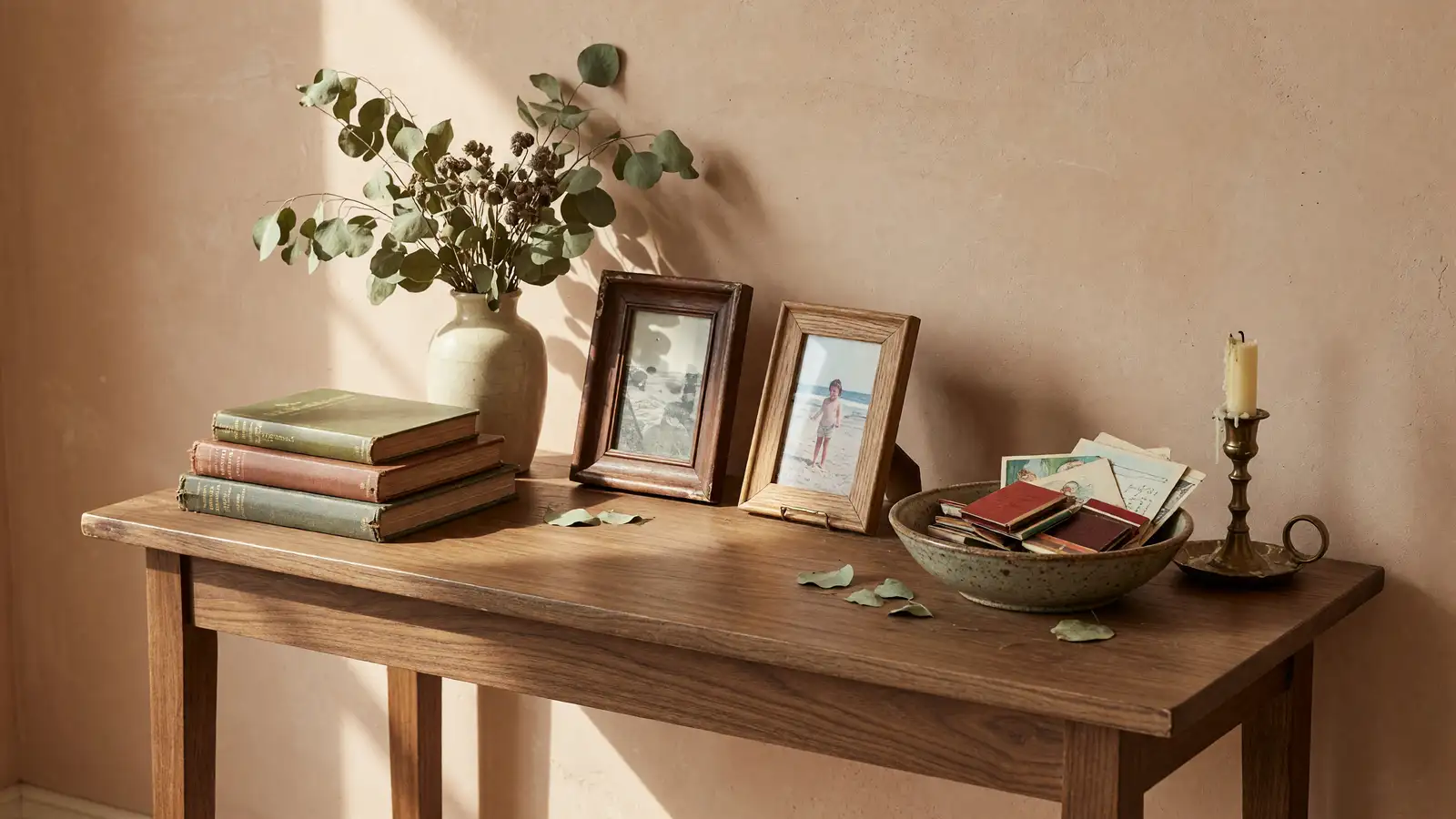
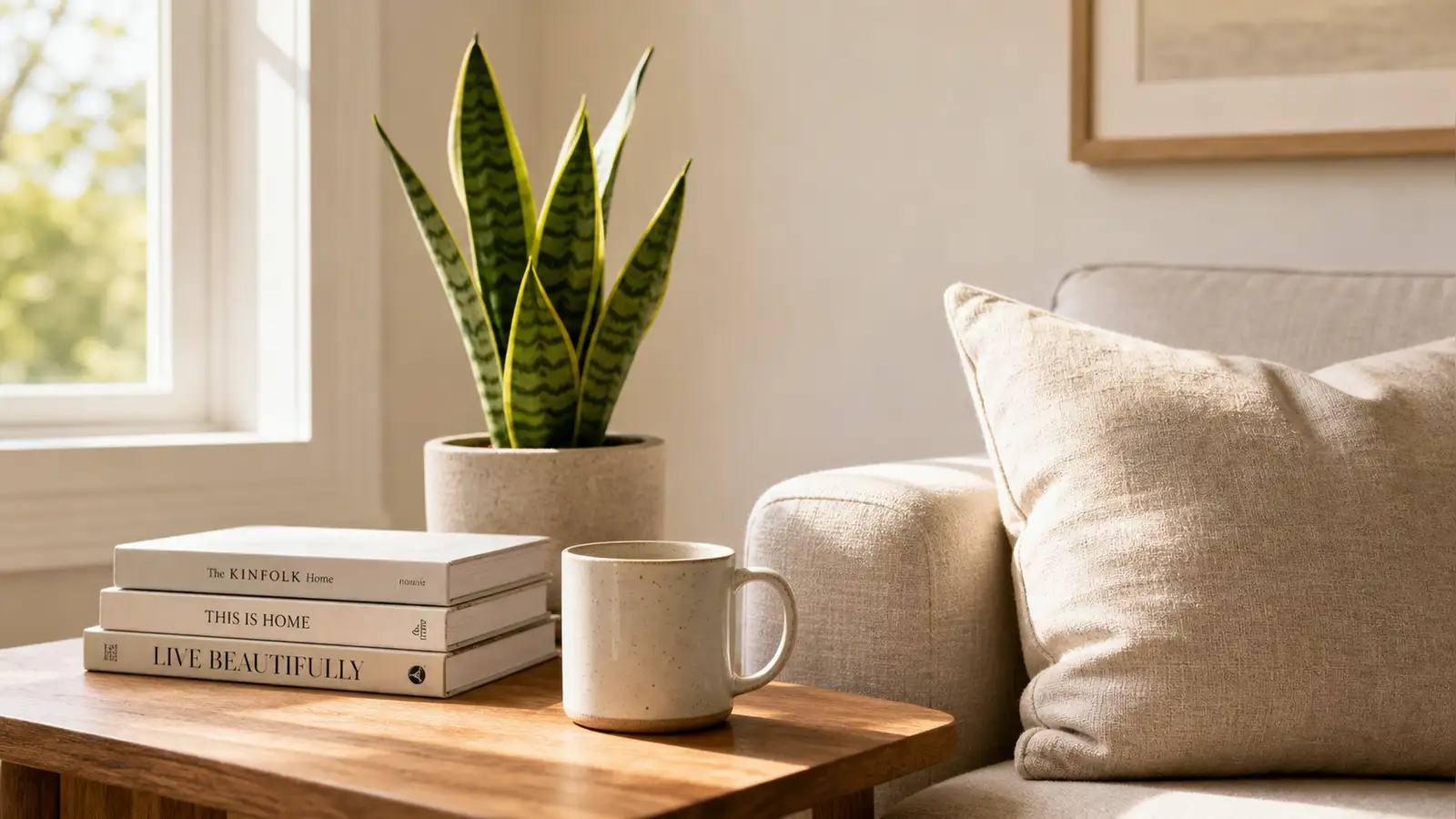
Personal objects are where most people get stuck. The old minimalism rulebook said clear surfaces at all costs. The 2026 version says be selective about what earns a spot, but don’t hide everything. A stack of three books you’re actually reading on the coffee table reads as lived-in, not messy. A ceramic mug from a trip on an open shelf signals personality without clutter. A single framed photo or piece of art that means something, instead of a gallery wall of generic prints, does more emotional work than an empty wall ever did. The rule isn’t “nothing on surfaces.” It’s “nothing on surfaces that you wouldn’t miss if it disappeared.”
Lighting is the underrated lever. Warm minimalism relies on pools of light at different heights rather than a single overhead fixture. A table lamp with a warm bulb (2700K or lower) in one corner, a floor lamp angled toward a chair in another, and maybe a small task light on a desk or shelf. Multiple light sources at varied heights create visual depth and a sense of enclosure without adding furniture or objects. It’s the cheapest way to make a room feel warmer, and it’s the thing most people skip.
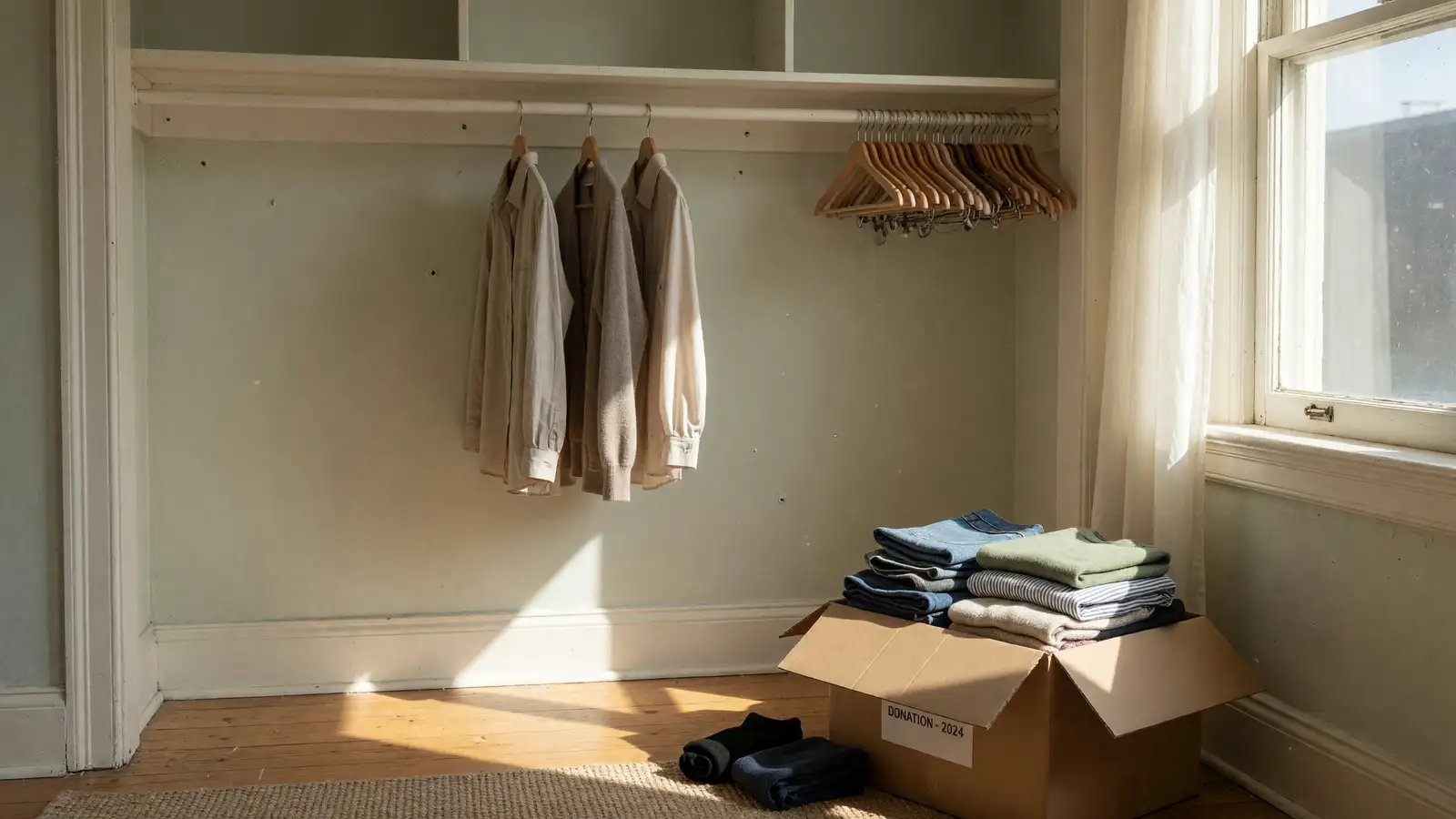
Editing, not purging. This is where warm minimalism connects back to the decluttering philosophy the site has always advocated. Our soft decluttering guide walks through the approach of keeping things that feel good in the space rather than chasing some abstract ideal of “enough.” Warm minimalism applies the same logic to what stays visible. You’re not asking “how little can I live with.” You’re asking “which of these things actually makes the room better.”
Why the shift is happening now
The timing isn’t random. Ross’s comment about AI fatigue points to something real. People surrounded by machine-generated images — flawless, frictionless, and somehow hollow — are gravitating toward physical spaces that feel unmistakably human. Imperfection, evidence of craft, objects with personal history: all of these push back against the algorithmic uniformity that’s creeping into every other part of life. A limewash wall with visible brush strokes is, in a small way, a rejection of the idea that everything should look machine-made.
There’s also a post-pandemic correction at work. The maximalist “more is more” that dominated 2021 through 2024 was a reaction to being stuck in the same four walls — people filled those walls with stuff because they were bored and anxious. Now that life has normalized, the visual noise feels less like comfort and more like clutter. But the solution isn’t to swing back to sterile white boxes, because people learned during lockdown that their homes need to actually feel good to be in. Warm minimalism splits the difference perfectly: fewer things, but each one chosen because it contributes something real.
This trend also sits inside the broader slow living and intentional design movement that’s been building for a couple of years. When a home feels warm and personal, you spend more time in it. When it feels like a staged listing photo, you don’t. Warm minimalism isn’t just an aesthetic choice — it’s a functional bet that a space with fewer, better things is a space you’ll actually want to inhabit.
The designers seem aligned on where this is going. The minimalism that survives past 2026 won’t be the version that strips a room down to zero. It’ll be the version that strips it down to what actually matters, and then makes sure what remains is something you want to live with. That might mean a room with only a dozen objects in it — but every one of them has a reason for being there beyond just filling empty space.
Sources: