You already have a fall list. Filters, gutters, the outdoor unit. We wrote that closed-house routine three days ago. This is the job that never makes those lists: the plastic bag from the cleaner, still on the hanger, still in the bedroom closet, still doing what plastic bags do. They trap air. Then they leak it.
ScienceDaily ran the Keck Medicine of USC paper on September 7. Tetrachloroethylene, PCE, the grease-cutting solvent behind a lot of dry cleaning, showed up in blood. People with detectable PCE were three times as likely to have significant liver fibrosis as people without it. That is a lab finding, not a chore chart. The chore is simpler than the paper: stop storing last week’s dry cleaning in a sealed sleeve next to the bed.
I am not going to tell you what to do with your liver. I am going to tell you what to do with the bag.
What the study actually counted
Brian P. Lee, a hepatologist at Keck Medicine, is the lead author. The paper is in Liver International. The data is not a clinic of dry-cleaning workers. It is NHANES, 2017 through 2020, adults 20 and older, PCE measured in blood.
Fox News’ write-up of the same release gives the sample size the press pages bury: 1,614 people. About 7% had detectable PCE. In a nationally representative survey, that is not a rounding error. It is also not “everyone who owns a wool coat.” Most of the country still came back clean.
The association held after age, sex, race, ethnicity, and education. There was a dose-response: more PCE in blood, more fibrosis. Lee’s line in the Keck release is the one that should sit next to the detergent: two people with the same health profile, and the difference might be an environmental exposure nobody asked about.
Fibrosis here means scar tissue in the liver. The paper and the press both say it can progress. That is as far as this site goes. If you want a medical plan, that is a clinician and a blood test, not a closet blog.
PCE is not a new villain. ScienceDaily notes the International Agency for Research on Cancer already calls it a probable carcinogen, with older links to bladder cancer, multiple myeloma, and non-Hodgkin lymphoma. The EPA has a 10-year phaseout of PCE in dry cleaning. Ten years is a long time to keep hanging bags in a closed bedroom while the industry slowly switches solvents.
The exposure route that matters in a house is not a Superfund site. It is air. Dry-cleaned clothing off-gasses. You breathe it. The study also flags drinking water after spills and bad disposal. That is a municipal problem. The bag is yours.
The bag is the reservoir
Plastic from the cleaner is not storage. It is a shipping sleeve. The shop puts it on so the shirt does not pick up rain between the counter and the car. Once the shirt is in the closet, the sleeve is a small greenhouse of leftover solvent.
You can smell it. That “clean” chemical sniff when you open the closet on a Tuesday is not fabric softener. It is the reason Lee’s group can find PCE in blood in people who do not work at a plant.
The higher-income twist in the Fox write-up is almost funny if you have ever paid for dress shirts by the pound. Lee said people with more money use dry cleaning more, so they show more exposure. The workers inside the shop are a different column. Prolonged, direct, all day. Your closet is not a plant. It is still a box of hanging plastic in a room where you sleep.
If you already run a capsule wardrobe, you have fewer of these bags. That is the only minimalism lecture in this piece. Fewer trips to the cleaner means fewer sleeves. The rest is handling the trips you still make.
Do this the day you get home, not “this weekend”:
- Cut or tear the bag off in the garage, the porch, or next to an open window. Not over the bed.
- Throw the plastic in the trash you actually take out. Do not “save it for donations.” Do not ball it up and leave it on the closet floor. It will still off-gas there.
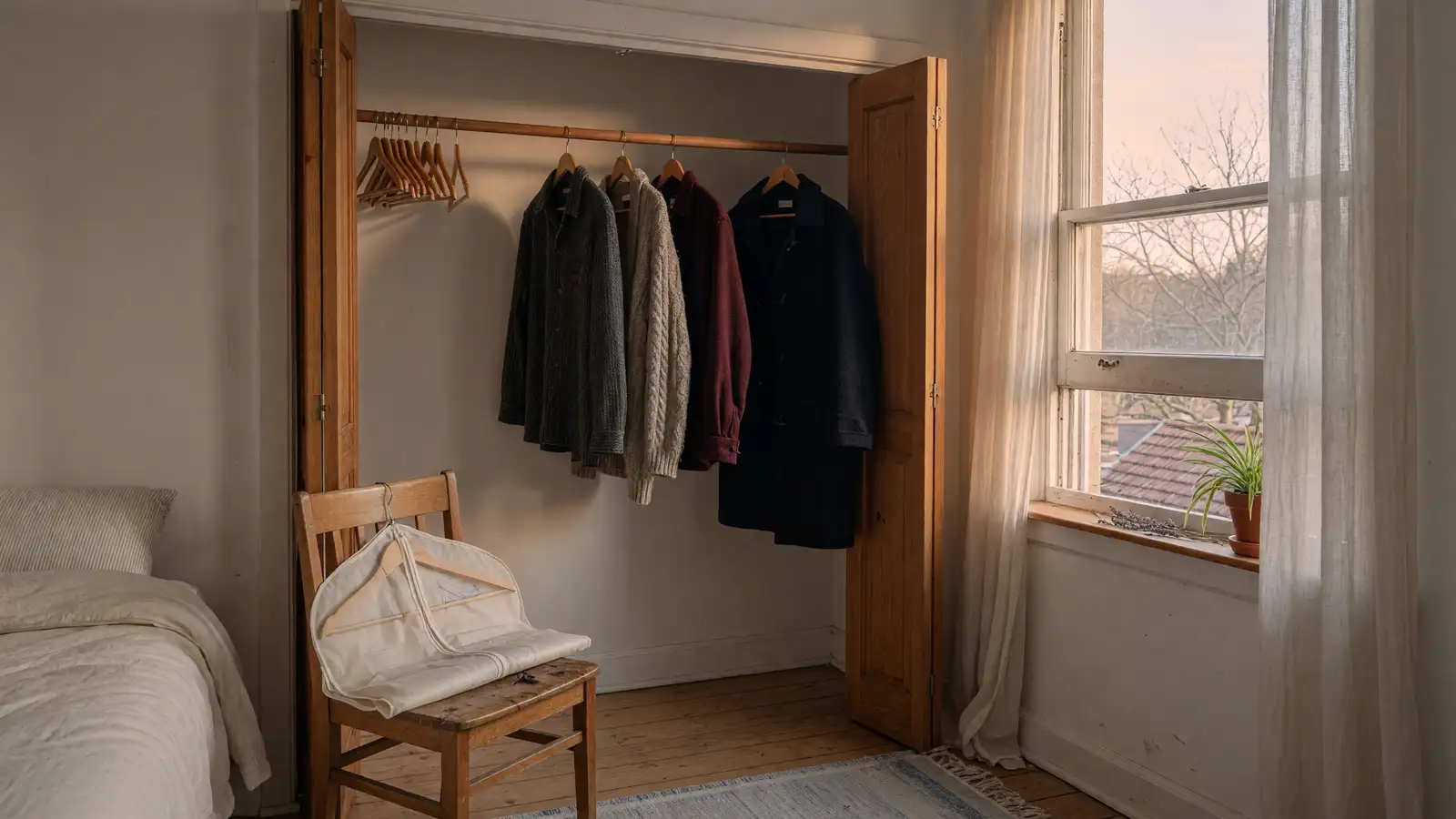
- Hang the clothes with space between them. Packed wool does not air.
- Leave the closet door open for an hour if the room can take it. If you already closed the house for heat, crack the bedroom window for that hour instead of dumping the load into the HVAC return. The air purifier guide is for particles. Solvent vapor is a different job. Vent first, then filter.
Wire hangers can stay or go. The bag is the thing. If the shop uses a reusable garment bag you own, air the clothes before they go in it. A zippered canvas tote is still a box if you zip it full of Monday’s perc.
Spot removers and the polish under the sink
PCE is not only a cleaner solvent. Keck lists arts-and-crafts adhesives, spot removers, and stainless steel polish. That is the cabinet you already organized, or meant to.
Pull the bottles. Read the back. Tetrachloroethylene, perchloroethylene, PCE, perc. If it is there, it does not belong in an open caddy on the counter next to the fruit. It belongs in a closed, labeled bin, away from the stove, and you use it with a window open or you stop using it.
This is not a reason to panic-buy a new “green” line because a homepage said plant-based. It is a reason to stop keeping a 2019 can of spotter that still smells like a shop. If you have not used it since the last wedding, you do not need it. We already walked through cleaning-supply storage. Add a rule: solvents get their own closed box, not a lazy Susan with the dish soap.
Stainless polish is the sleeper. People wipe the fridge door on a Sunday and leave the rag on the counter. If the polish is a perc product, you just put a solvent film in the kitchen air and then cooked. Use soap and water on stainless unless you have a stain that actually needs a dedicated product. Most “streaks” are water. Most “I need the purple bottle” is habit.
Craft glue is the other sleeper if you have kids or a hobby table. Arts-and-crafts adhesives are on Keck’s list. That table should not live in the bedroom. If it does, you now have two off-gassing hobbies next to the pillow.
I am not going to list brands. Formulas change. The label is the source, every time you buy, not a blog post from September.
A closet airing routine that fits a weeknight
You do not need a Sunday project. You need a rule that survives Thursday.
Pickup day. Unbag before the clothes enter the bedroom. If you are tempted to “just hang them for now,” that is how the bag stays until spring.
One shelf, one pass. While the closet door is open, pull the stuff that is still in retail plastic, dry-cleaning plastic, or a sweater bag you never unzipped. Retail plastic is not PCE. It is still dead air and a dust trap. Same motion.
Coat rotation. Fall is when the wool comes back from the off-season bin. If those coats went to the cleaner in April and have been in bags in the basement since, unbag them in the garage. Leave them on a rack for a day before they share a closet with the rest of the clothes. Basements are damp. Bags in basements are damp plastic plus leftover solvent. That is two problems.
The “emergency” shirt. People keep one dress shirt in a bag “so it stays clean.” It does not stay clean. It stays wrapped. Put that shirt in a breathable garment bag, or on a hanger with a cotton pillowcase over it if you are traveling tomorrow. Plastic is for the car ride.
Frequency. If you dry-clean once a month, this routine is five minutes. If you dry-clean a household of uniforms every week, put a hook in the mudroom and make that the unbag station. Do not walk bags through the whole house.
None of this replaces the 15-minute daily habit if that is how you keep the rest of the house from sliding. It is a specialized five minutes on a specific day. Mixing it into “wipe the counters” is how it never happens.
Workers, customers, and what you cannot clean
Lee’s comment about shop workers is the part homeowners skip because it is not their closet. People who stand next to machines all day are not doing a bag routine. They are in an occupational exposure. EPA phaseout and workplace rules are the lever there, not a blog checklist.
If someone in your house works at a cleaner, their clothes from the shift are a different load. Those clothes should not go straight into the family closet in the same bag the shop handed the customer. Change at work if they can. If they cannot, that outfit gets its own hamper and a wash, not a shared rod.
Customers still have the 7% figure. Detectable blood PCE in a general adult sample means the solvent is not staying at the plant. The phaseout will take a decade. Shops will keep using what they have. You can ask your cleaner what solvent they use. Some already switched. Some will say “organic” and mean nothing. “Perc-free” or a named alternative is a real answer. “We use a special fluid” is not.
You can also clean fewer things at the shop. Wool coats, yes, if you cannot wet-clean them. A polyester blouse that survived a restaurant, maybe not. Every skipped trip is one less bag.
Water contamination, the other route in the ScienceDaily piece, is not a closet job. If you have a well and an old industrial neighbor, that is a test, not a vinegar rinse.
What this is not
It is not a diagnosis. A 3x association in NHANES is not “your closet gave you liver disease.” Fibrosis has the usual list: alcohol, fat, hepatitis. Lee’s point is that environment may explain a leftover slice. That is a research sentence. It is not a reason to throw out the winter coats.
It is not a boycott manifesto. Dry cleaning still has a job for structured garments you cannot wash at home. The routine is unbag, air, and stop treating the sleeve like storage.
It is not a product review. I am not ranking steamers, “perc-free” shops, or ozone cabinets. A cracked window and a trash can handle the bag. If you want to spend money, spend it on a cleaner who will say the solvent name without a shrug.
It is not the same article as the HVAC one. Filters catch dust. They are not a solvent plan. Run both. Do not skip the filter because you unbagged a shirt, and do not skip the shirt because you changed a filter.
If you only do one thing after reading this: the next time you come home with a swinging plastic sleeve, take it off before you open the bedroom door. Hang the clothes. Pitch the bag. Leave the closet open while you make dinner. That is the whole method. The study will keep getting quoted with the word “triple” in the headline. Your job is smaller, and it is on a hanger.