The smell is not a personality trait of your machine. It is a timer you missed.
On September 17, phys.org ran a textile scientist’s briefing on why laundry goes sour if it sits wet. The useful number is not a brand. It is 30 to 60 minutes. That is the window from washer to dryer, or to a line with actual air. After that you are farming bacteria and fungi in a warm, dark, damp pile you still call “the wash.”
Four days earlier, Family Handyman’s writer had already paid a technician to learn a smaller lesson. The drum had been cleaned. The dispenser drawer had been cleaned. The door-seal slime had been cleaned. Clothes still came out sopping and stale. The tech did not replace a pump. He pointed at two habits: too much detergent, and a drum packed until nothing can rinse.
This is a cleaning routine, not a shopping list. You already own the machine. The job is to stop feeding it.
The 30–60 minute rule is the whole schedule
The phys.org piece is blunt about prevention. Move the load. Dry it fully. Dry it fast. Airflow is not a lifestyle word here. Drying takes away the conditions microbes like. If you leave a wet basket in a closed bathroom, you did not finish the cycle. You started a second one without soap.
Hospital laundry studies, as cited there, keep repeating the same pairing: heat plus thorough drying. Cold water is cheaper. It also lets odor bacteria live in the clothes and in the machine. That is the part people skip when they brag about cold washes. Energy math is real. So is a biofilm in the gasket.
Not every textile wants 60°C / 140°F. Check the label. The scientist says it is worth a shot if the load already smells funny and the fabric can take it. Enzyme detergents also have temperature ranges. The bottle is not poetry. If the enzymes want warmer water than you set, you bought a scent and a hope.
A Saturday “deep clean” does not rescue five ignored weeknights. Put a cheap kitchen timer on the washer when you start it. When it rings, you either transfer the load or you admit you started a job you cannot finish. Start fewer loads. Finish the ones you start.
We already treated the dryer vent as a fall fire job. A clogged vent makes drying slow. Slow drying is the biology problem with extra steps. If the load takes forever, clean the vent before you buy a new detergent.
Extra soap is residue, not hygiene
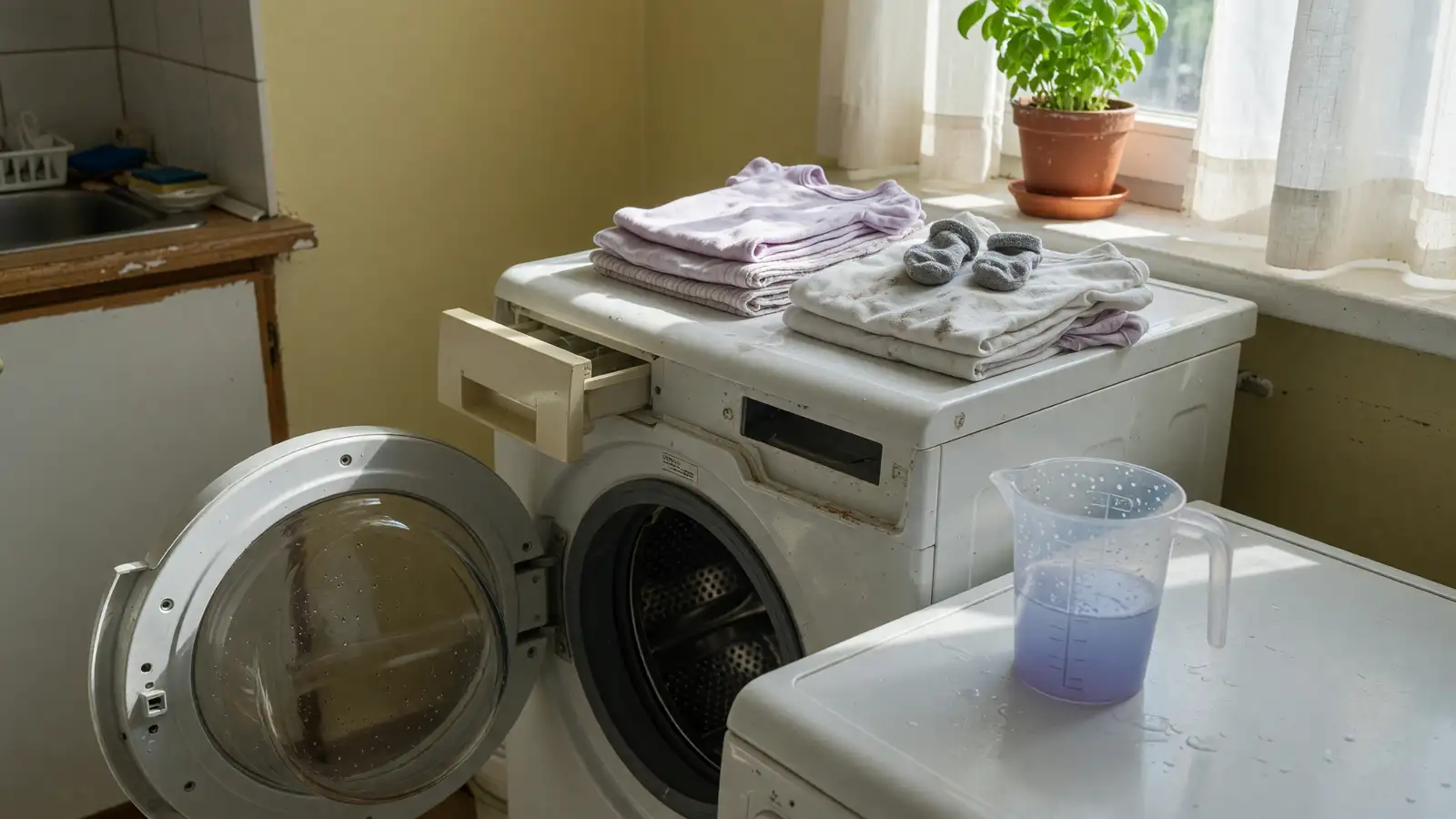
The Family Handyman writer believed a heavy scoop would keep clothes “fresh.” It interfered with rinsing. Residue stayed. Water stayed. Smell stayed. Overpacking did the same thing: not enough motion, not enough rinse, clothes that feel wet when they should not.
Jennifer Ahoni, a P&G Fabric Care principal scientist quoted in that piece, points at the cleaning cycle your manual already describes. Run it. Wipe the places residue actually lives: drawer, seal, the underside of the door you never look at. She mentions a dedicated washer cleaner used as directed. She also mentions auto-dosing on newer machines as a way to stop guessing. Auto-dosing is not magic. It is a ceiling on your right hand.
The other number in that article is easy to misuse. Ahoni says up to 70 percent of soils on clothes are invisible: body oils, sweat, odor soils. That is an argument against starving the wash, not an argument for filling the cup past the line. Too little soap leaves oils. Too much soap leaves soap. Both smell. The line on the cap is the experiment you skip.
Hard water is the legitimate extra. The article’s Gagliardi advice is boring on purpose. Ask the water utility how hard the supply is, or test it. If it is hard, liquid detergent and a measured bump above the baseline beat a second scoop of powder “just in case.” Metals like iron and manganese are a water problem. They are not a reason to drown a T-shirt.
If garments already stink, rewash them once with a correct dose and a looser drum. Do not stack three rescue cycles with three extra scoops. That is how you pickle cotton in surfactant.
Workout clothes are a different fabric, not a different religion
NBC Select asked laundry people whether workout gear needs a sink. The useful parts are small.
If you machine-wash, turn pieces inside out so the sweaty face meets water and soap. Zip the zippers so they do not chew everything else. Put a sports bra in a bag so hardware does not become a weapon. Torres’s list is that short.
Detergent: mild, gentle, or a sport formula if odor is the actual problem. A cloying scent is not clean. It is cover. The Select write-up even flags that some “sport” liquids exist because regular detergent leaves bacteria that still smell after the rinse.
If you hand-wash, Aparacio’s dose is a teaspoon in cold water, soak up to 30 minutes. Hot water can wreck delicates. You do not need a basin ritual every night. You need a teaspoon on the days the machine is wrong for the fabric.
Synthetics hold oil in a way cotton does not. That is why a “clean” running shirt still smells when you sweat again. The 30–60 minute dryer rule still applies. A damp sports bra on a chair is a petri dish with straps.
Do not mix a muddy trail load with towels and then congratulate yourself for using cold. Separate the stink. Wash it sooner. Dry it completely. If you cannot dry it the same hour, do not start it.
Pet beds can go in the machine. Hair cannot.
ABC News asked Australian scientists whether a pet bed can share a washer with human clothes. Associate professor Rietie Venter, antimicrobial resistance lead at Adelaide University’s School of Pharmacy and Biomedical Sciences, called a separate pet-bed cycle low risk from a hygiene angle. The sentence people want is “it’s fine.” The sentence she actually gave is “by itself.”
Hair is the mechanical problem. A heavy-shedding dog will clog the machine if you skip the vacuum or the lint roller. Removable covers are the sane design. Some foam beds go in whole; Venter’s own dog has one that survives it. Low-fragrance detergent, because a dog does not need a linen mist.
If you have no dryer, she wants a warm, sunny day with no rain. Same biology as the phys.org clock. A damp dog bed in a laundry room is how you get a smell you will blame on the animal.
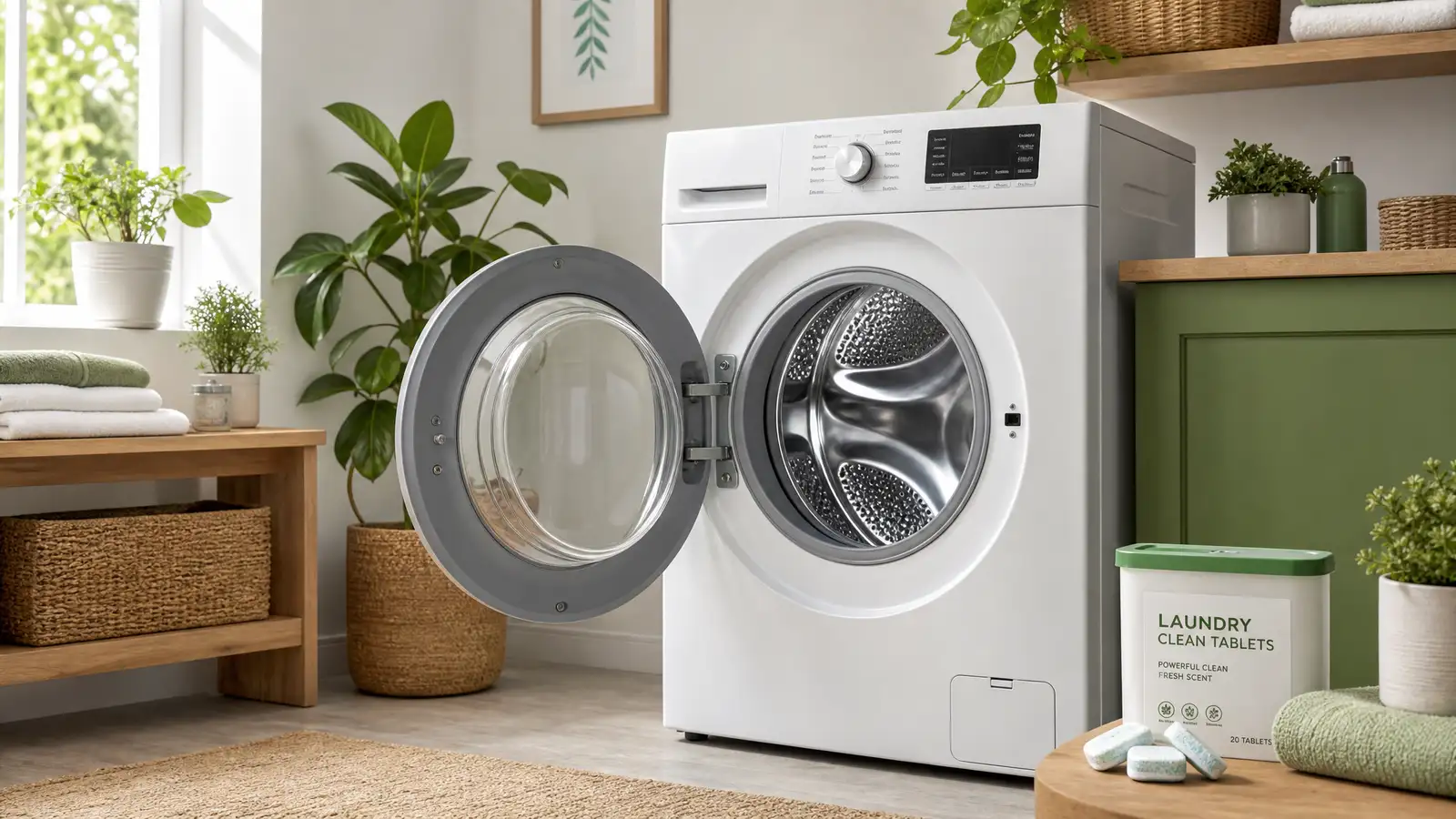
A man identified as Mr Leaney, in the same ABC piece, treats the machine after the pet load: wipe seals, two basic dishwasher tablets, longest hottest cycle you have, then an empty flush. That is adjacent to how we already talk about dishwasher maintenance. Tablets are chemistry, not a personality. Do not overpack. Check the kilogram capacity in the manual. An unbalanced, half-washed, wet bed is worse than a dirty one you have not started.
Some laundromats keep machines for pet bedding. If your washer is small and the bed is not, that is the adult option. Bragging that you “make it fit” is how you buy a service call.
We have older notes on pet hair tools and laundry-room layout. Layout does not replace the hair-removal step. A pretty hamper full of fur is still fur.
A weekly washer cleaning that is not a performance
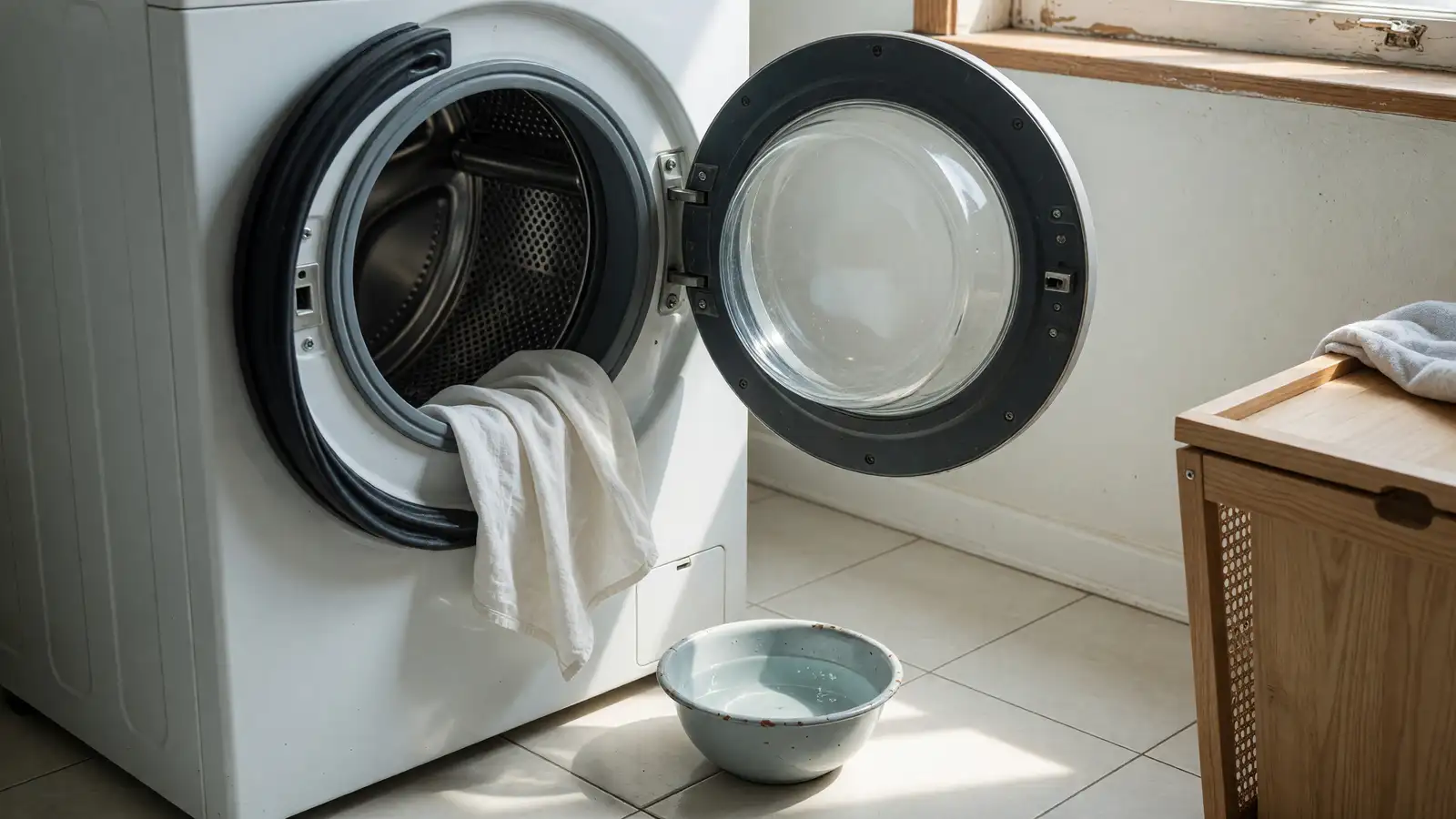
Pick one hot empty cycle a week if you wash cold the rest of the time. Wipe the gasket while the drum is still wet, because slime peels easier then. Leave the door ajar when you are done. A closed wet machine is a terrarium.
Oxygen bleach and enzyme boosters, from the phys.org briefing, are for biofilm and for loads that already went wrong. They are not a daily personality. A hot maintenance cycle plus wiping the drawer breaks the reinoculation loop the scientist described. If you skip the wipe, the next cold load inoculates itself from the seal you left.
Do not pour random kitchen fluids into a HE machine because a comment thread said vinegar is moral. Use the cleaner the manual names, or the empty hot cycle, or the two dishwasher tablets after a pet load. Then flush. Then dry the next real load on time.
Bathroom mold is a cousin, not a twin. The mold-prevention routine is about grout and fans. The washer is about standing water in fabric. Same kingdom of organisms. Different room.
What not to do this week
Do not leave a wet load “until after dinner.” Dinner is how you get 90 minutes. The scientist’s window is 30 to 60.
Do not add detergent because the clothes were extra dirty. Add a second, correctly dosed wash, or pretreat the stain. Extra soap in one cycle is how you keep the dirt and the soap.
Do not wash the dog bed with the school uniforms to “save a cycle.” Venter’s advice is separate. Hair and dander are not a moral failing. They are lint.
Do not hand-wash every sports bra forever because an article mentioned a sink. Use the bag, the inside-out trick, the gentle liquid, and a dryer that actually finishes. The sink is for the pieces the machine wrecks.
Do not treat auto-dosing as a reason to ignore the drum. Auto-dosing measures soap. It does not unload the machine.
If you share a machine with roommates, put the 30–60 minute rule on a note on the lid. The scientist’s window dies when four people each assume someone else will move the wet pile. A group text is not a dryer. Name one person per load. That person owns the transfer, including the dryer.
Leave the washer door open. Leave the detergent at the line. Move the wet clothes while the timer still has authority.
The New Yorker is not involved this time. Neither is a storage unit. This is a wet pile and a scoop. Set the timer. Use the line on the cap. Dry the thing before it becomes a science fair.