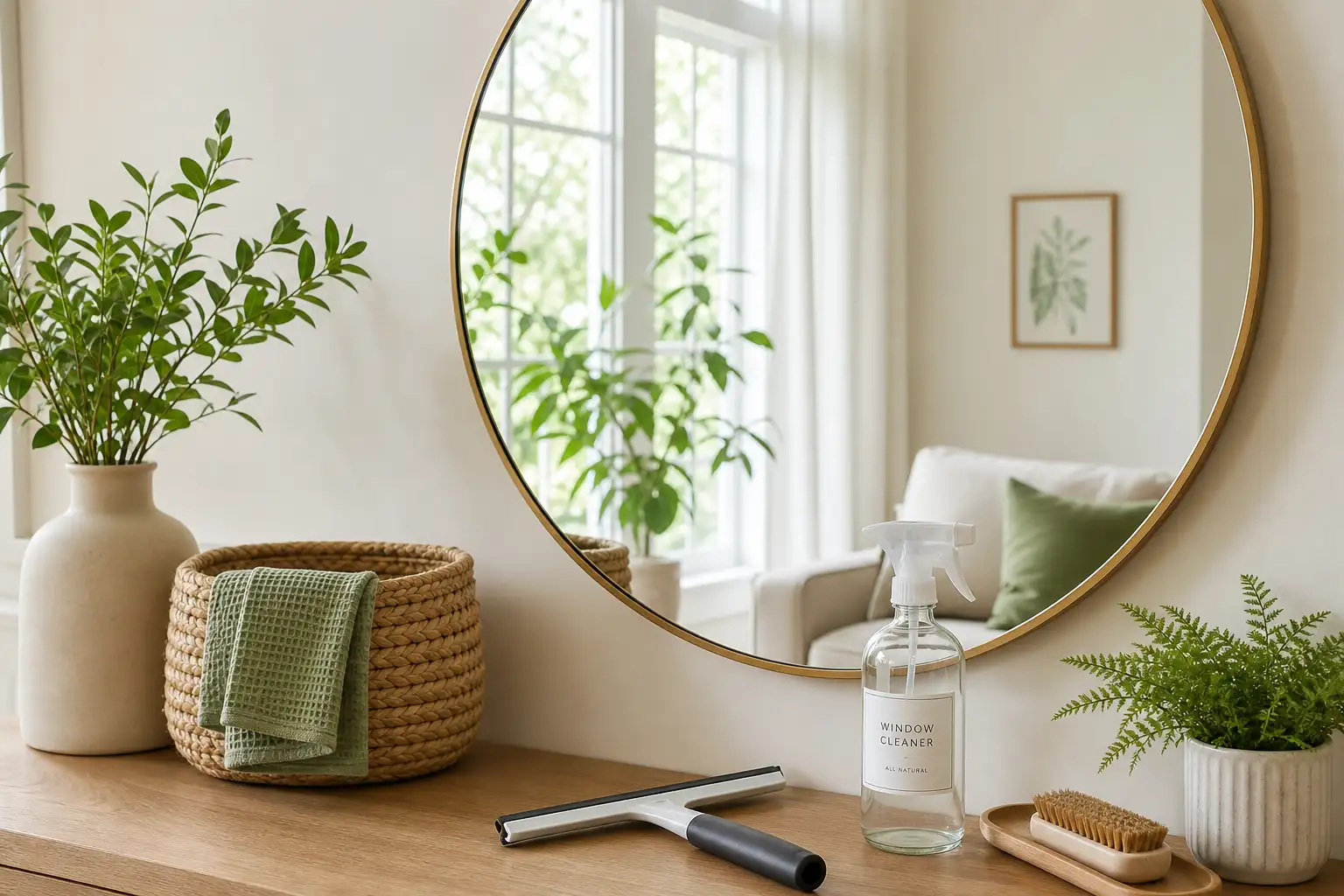
A streaky mirror is one of those small frustrations that seems to defy solution. You spray, you wipe, you admire your work, and then the bathroom light hits the glass from a different angle and reveals a constellation of smears that look worse than the toothpaste splatter you were trying to remove. The problem is almost never the cleaner. It is the technique and the cloth.
Professional mirror cleaning uses two cloths and a specific motion that eliminates streaks reliably. Once you learn it, you will never struggle with mirrors again.
The Two-Cloth Method
The first cloth applies the cleaner and loosens the dirt. The second cloth removes the cleaner and polishes the glass. Using a single cloth for both steps simply redistributes the dirt and leaves behind the residue that becomes streaks when it dries.
A microfiber cloth is the best material for both steps. The split fibers trap dirt and cleaner without leaving lint, and the cloth can be washed and reused hundreds of times. Paper towels disintegrate when wet and leave behind a haze of paper fibers that is nearly as annoying as the original dirt.
Spray the cleaner onto the cloth, not onto the mirror. Spraying the mirror directly sends cleaner into the frame and behind the glass, where it can damage the silver backing over time. A dampened cloth applies cleaner precisely where you want it without overspray.
The Motion
The wiping motion matters. Circular wiping moves dirt around without removing it. Vertical or horizontal straight-line wiping removes dirt efficiently, but the edges of each stroke create lines that become visible as the cleaner dries.
The professional technique is an S-pattern: start at the top left corner and wipe in a continuous overlapping motion that resembles a series of connected S curves. The overlapping pattern ensures no gap between strokes. Work from top to bottom so any drips are picked up by subsequent passes rather than drying on the glass.
Immediately after the cleaning pass, follow with the dry cloth in the same S-pattern. The dry cloth picks up any remaining moisture and the microscopic residue that would dry into streaks. Do not skip this step. It is the difference between good and perfect.
The Cleaner
Commercial glass cleaners work, but the simplest and most effective mirror cleaner costs pennies. Mix equal parts white vinegar and water in a spray bottle. The vinegar’s acetic acid dissolves the film of hairspray, toothpaste, and hard water deposits that accumulate on bathroom mirrors. The solution has no dyes, perfumes, or additives that can leave residue.
For mirrors with heavy buildup, a drop of dish soap added to the vinegar solution cuts through the oily film from aerosol products. Use one drop per cup of solution. More is not better and will leave soap residue that attracts dust.
For the final polish, nothing beats a dry microfiber cloth that has been washed without fabric softener. Fabric softener coats the cloth fibers and transfers to the glass as a nearly invisible film. Wash your microfiber cloths separately from other laundry, with detergent only, and air dry or tumble dry on low without dryer sheets.
The Frequency
Bathroom mirrors need cleaning more often than other mirrors because they are exposed to aerosol products, toothpaste, and humidity. A quick wipe with a dry microfiber cloth daily removes the light film before it builds up. A full wet cleaning once a week maintains crystal clarity.
Other mirrors in the home can go weeks between cleanings. The kitchen mirror near the stove gets a greasy film that requires the vinegar solution. Entryway and bedroom mirrors usually need only dusting with a dry microfiber cloth.
A streak-free mirror is a small domestic victory that you see every time you look at your reflection. The technique takes slightly longer than spraying and wiping haphazardly, but the result is a mirror that looks professionally cleaned for days rather than minutes.