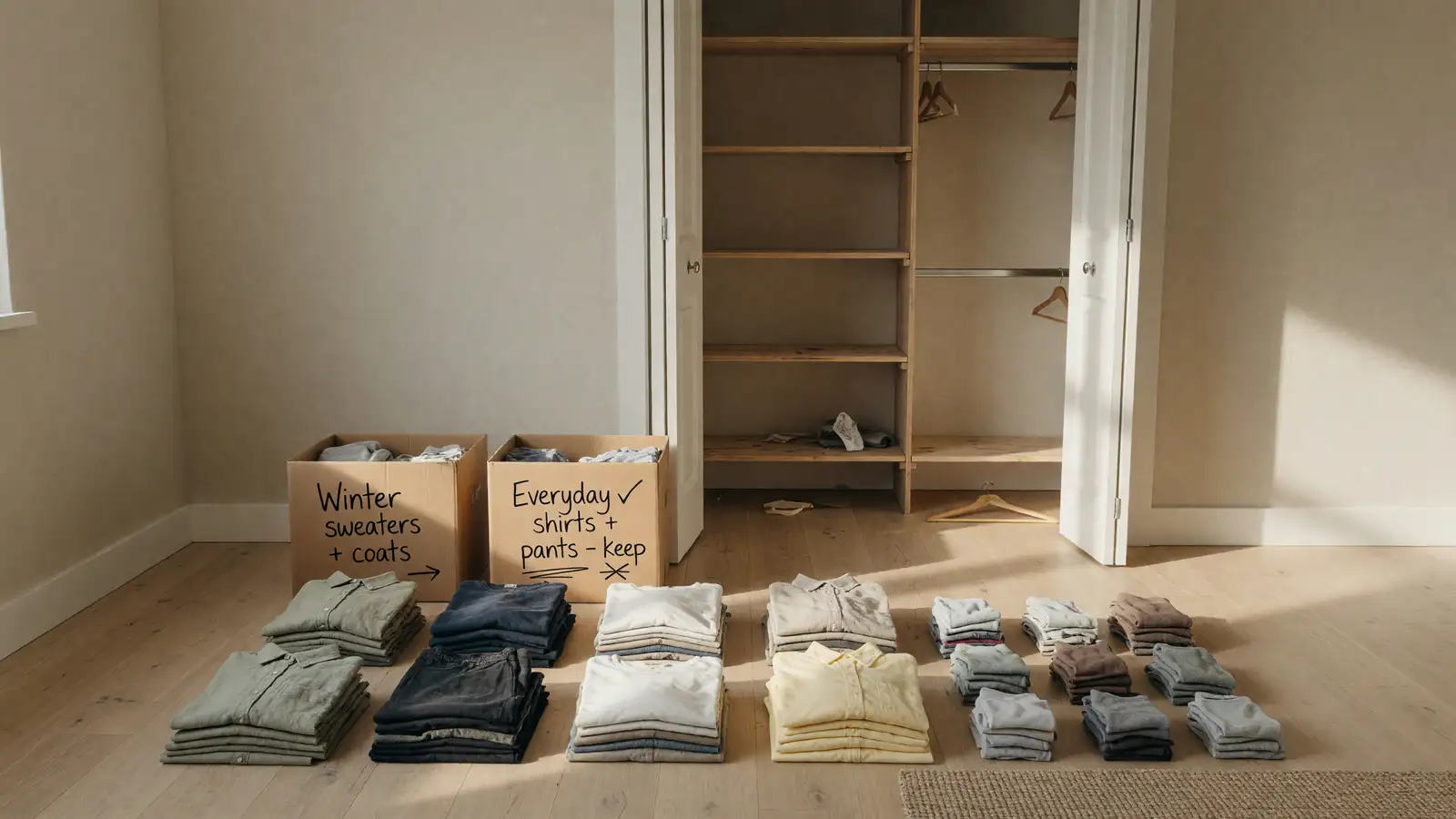
The size of your laundry pile is directly proportional to the size of your wardrobe. This sounds obvious once you hear it, but most people never make the connection. A closet stuffed with clothes means laundry can be ignored for weeks. When you finally face the mountain, it takes an entire Saturday. A minimalist wardrobe means you run out of clothes faster, which means you do laundry more often, which means each laundry session is smaller and faster.
The math is simple. Own fewer clothes, do less laundry. Not less laundry overall — you still wash what you wear — but less laundry at any single moment. The pile never grows beyond what fits in one or two loads.
The Relationship Between Wardrobe and Laundry
A person with thirty shirts can go a month without doing laundry. At the end of that month, they face four loads of just shirts, plus pants, socks, underwear, towels. The task is so large it requires blocking out a weekend. The sorting alone takes half an hour. The folding takes an hour. The dread of the task grows in proportion to the pile.
A person with ten shirts runs out in about ten days. They do two loads of laundry in under two hours, including folding and putting away. The task is small enough to fit into a weekday evening without resentment.
This is the hidden cost of a large wardrobe: laundry debt that accumulates silently in the hamper. Every extra shirt, every backup outfit for a hypothetical occasion represents laundry that must be done eventually.
Reduce your wardrobe and you reduce your laundry debt. The pile can only grow as large as the clothes you own. When the pile is small and manageable, laundry stops being a dreaded chore and becomes a simple maintenance task.
The Three-Hamper System
Sorting laundry is the bottleneck. When clothes are all tossed into one hamper, sorting happens at the washer, which means you are standing over a pile of dirty clothes deciding what goes where, and that decision fatigue makes the whole task feel harder than it is.
The three-hamper system sorts at the source. Three hampers, bins, or bags, side by side. One for lights, one for darks, one for delicates. When you take off a shirt at the end of the day, it goes directly into the correct hamper. No sorting later. No standing over a pile of mixed laundry making dozens of micro-decisions.
The hampers do not need to be large. In a minimalist wardrobe, each hamper might hold only a week’s worth of clothes. A simple divided laundry sorter on wheels works perfectly. For tight spaces, three tall slim bins lined up against a closet wall take up less than two feet of floor space.
This system also prevents laundry disasters. The red sock never ends up in the white load because it never shared a hamper with whites. Delicates never get washed on heavy duty because they had their own bin from the start.
One Load a Day
The one load a day habit transforms laundry from a weekly ordeal into a daily non-event. Start a load in the morning while the coffee brews. Move it to the dryer before leaving for work or starting the day. Fold it in the evening while watching something. Ten minutes of active effort spread across the day.
This rhythm works because laundry machines do most of the work. The washer runs for forty minutes while you do other things. The dryer runs for an hour. Your involvement is loading, transferring, and folding. Each step takes two or three minutes.
A family of four might run a load every day. A single person might run a load every two or three days. The frequency is less important than the consistency. When laundry is a daily background process rather than a weekend production, it loses its power to overwhelm.
The one load a day habit requires a minimalist wardrobe to work. If you have enough clothes to go two weeks between washes, there is no pressure to do laundry daily, so the habit never forms. The smaller wardrobe creates the gentle urgency that makes the habit stick.
Why You Cannot Procrastinate with Fewer Clothes
Procrastination thrives on buffer. The more buffer you have — more clothes, more time, more options — the easier it is to delay. A closet with thirty shirts provides a month of buffer. A closet with ten shirts provides ten days.
When your favorite jeans are in the hamper and you only own three pairs, you do laundry before you run out of jeans. When you own twelve pairs, the favorite jeans can sit in the hamper for weeks while you cycle through the backups and the laundry pile grows untouched.
The minimalist wardrobe removes the buffer that enables procrastination. You do laundry because you need clean clothes for tomorrow. The task becomes non-negotiable, which makes it simpler. There is no internal debate about whether today is laundry day. The empty drawer answers that question.
Air Drying for Longer-Lasting Clothes
Smaller loads make air drying practical. A drying rack holds one load of laundry. When every load is small, every load can be air dried. No dryer sheets, no lint trap, no shrinkage, no fading from high heat.
Air drying extends the life of clothes dramatically. Dryer heat breaks down elastic, fades colors, and weakens fibers. Jeans air dried last years longer than jeans run through the dryer. T-shirts keep their shape. Delicates stay delicate longer.
The drying rack also serves as a visual cue. Clothes hanging on the rack are visible, which creates a gentle pressure to fold and put them away. Clothes sitting in a dryer are out of sight and out of mind until someone needs the dryer for the next load.
The minimalist laundry routine is not really about laundry. It is about owning fewer clothes and discovering that the chore shrinks along with the wardrobe. Less to wash, less to sort, less to fold, less to put away. Laundry stops being a problem when the pile can never grow bigger than a single load.