The big stuff usually takes care of itself. You own one couch. One dining table. One bed. These items sit where they sit. Nobody loses a couch behind the nightstand.
The small stuff is what grinds the morning down. One earring. A hair tie that was right there a minute ago. The remote that somehow ended up in the kitchen. Lip balm, keys, a charging cable you swore you plugged in last night.
These are not storage problems in the traditional sense. You don’t need a shelving unit for your earrings. What you need is a system that respects how small items actually behave: they scatter, they hide under each other, and they multiply when you are not looking.
I came across a few unconventional approaches worth sharing — most of them involve items you probably already own or can grab for under $15.
Why Small Items Are the Hardest to Organize
Large items have gravity. A stack of sweaters stays in the closet because moving it takes effort. A pair of earrings weighs less than a paperclip. It takes zero effort to drop them anywhere — on the nightstand, in the bathroom, next to the sink, into a jacket pocket you won’t wear again for six months.
The other problem is visual noise. Ten small items scattered across a surface look messier than one large item taking up triple the space. Your brain registers the chaos before it registers what any individual object actually is. This is why even a “clean” room can feel cluttered when the surfaces are busy with small things.
There is also a psychological component. Small items are easy to acquire and hard to notice accumulating. You don’t accidentally buy three couches. You absolutely end up with seventeen lip balms, twelve charging cables, and a drawer full of pens you never chose to keep — they just appeared. The sheer volume of tiny items in an average home is orders of magnitude larger than the number of large items, but we rarely budget storage space accordingly. A six-foot closet for thirty shirts makes sense on paper. A single junk drawer for two hundred small objects does not.
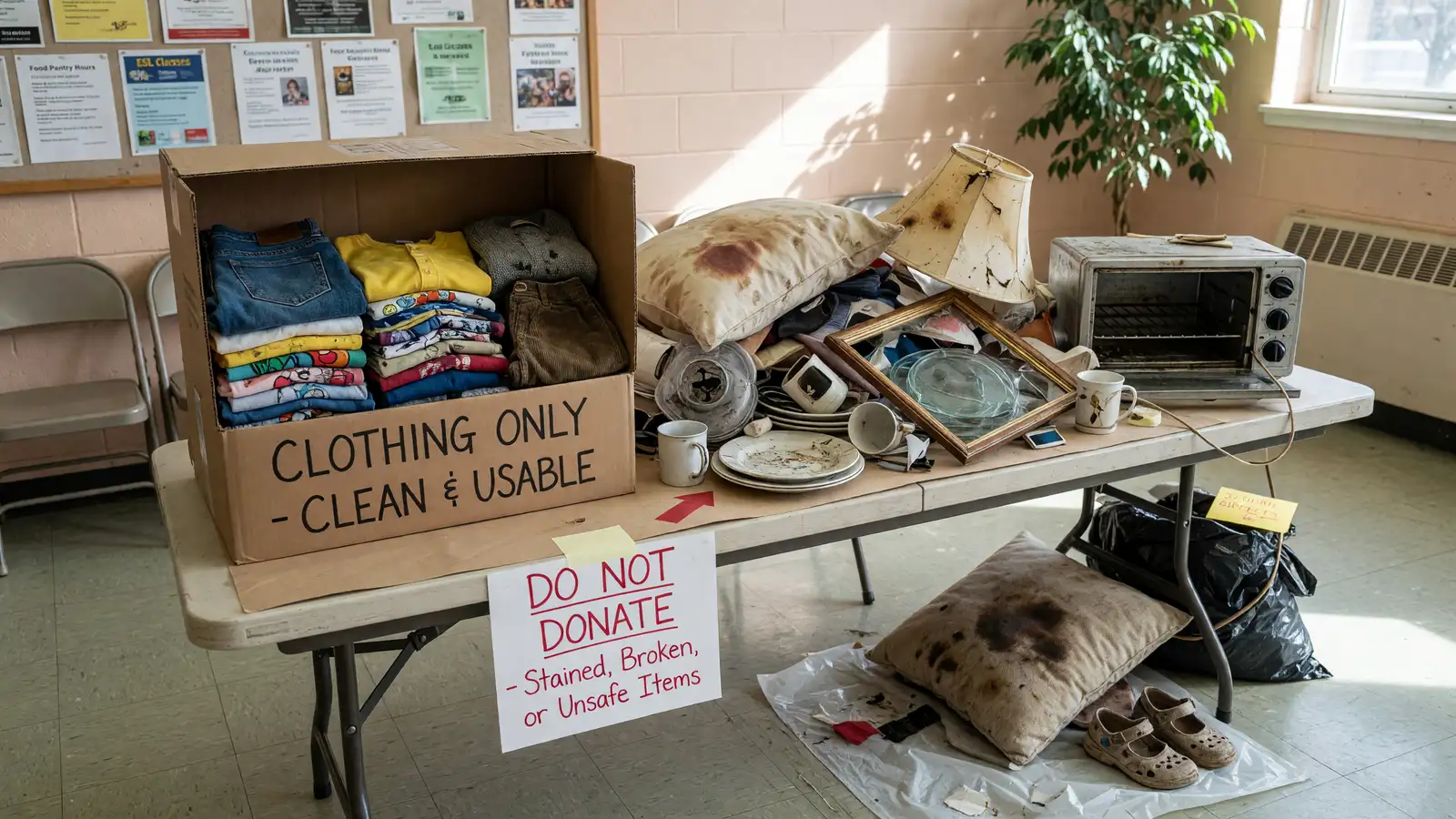
Professional organizer Kathy Vines puts it bluntly: before you organize anything, get rid of the stuff you don’t use. That old gaming console taking up a shelf. Board games your kids outgrew three years ago. DVDs you haven’t touched since 2019. Donating or discarding these first makes everything else easier to manage.
The Paint Palette Trick and Other Artist-Supply Wins
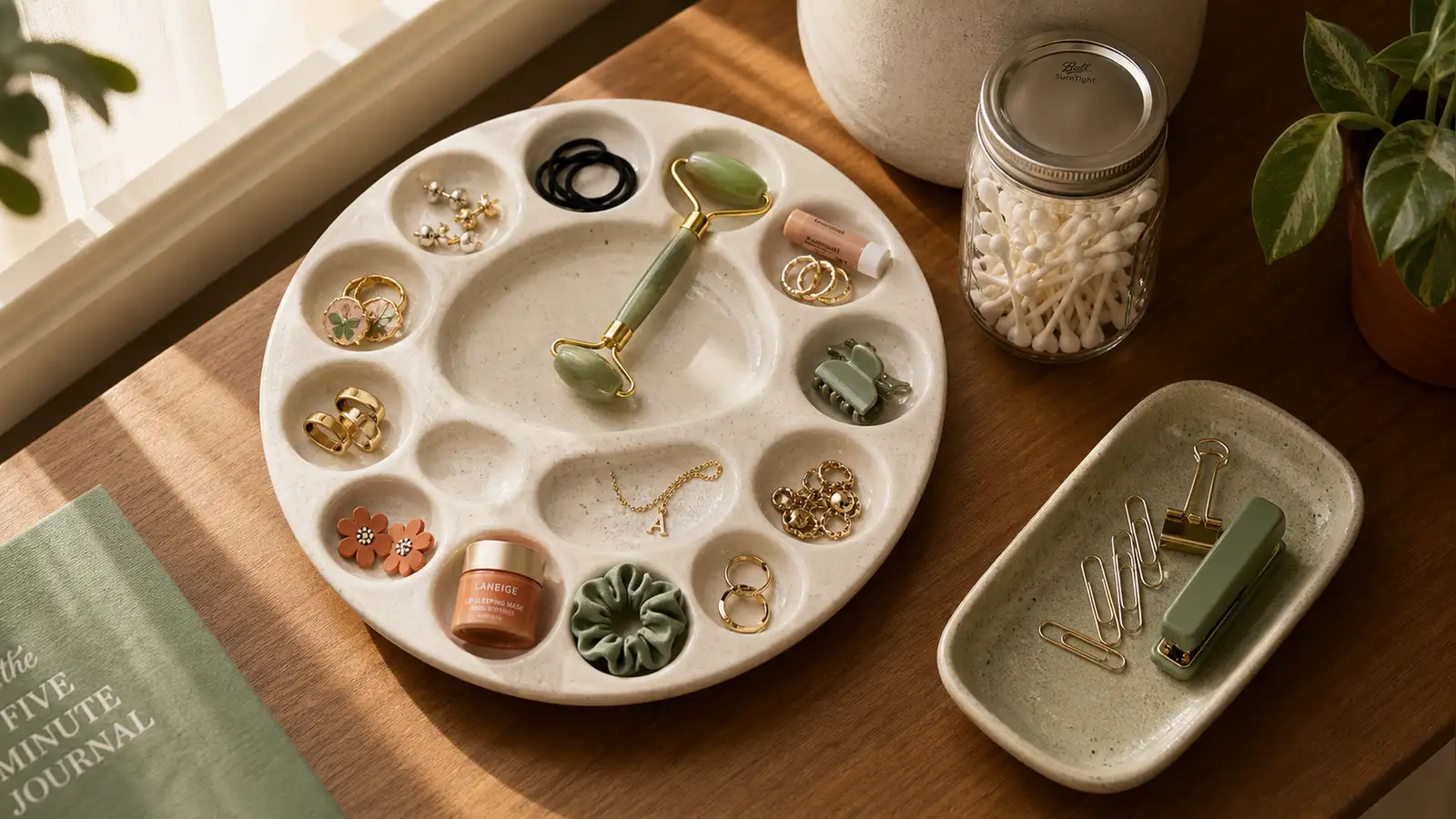
The smartest small-item organizer I have come across is a ceramic paint palette. The kind with fourteen shallow wells designed for mixing watercolors. Placed on a nightstand, each well becomes a dedicated home for one category of tiny item: stud earrings in one, hair ties in another, a jade roller resting in the brush holder, lip balms where they won’t roll onto the floor.
What makes this better than a regular trinket dish is separation. In a bowl, everything piles on top of everything else. A specific pair of earrings sinks to the bottom under three hair ties and a bottle cap you don’t remember opening. The palette forces every item into its own compartment. You can see everything at once without digging.
The ceramic weight matters too. Plastic organizers slide around when you reach for something half-asleep at midnight. A heavy ceramic palette stays put. And if you prefer your surfaces completely clear, the whole thing slides into a nightstand drawer just as easily — still keeping items separated, just out of sight.
This same principle extends to other artist supplies. A brush roll meant for paintbrushes works identically for makeup brushes, keeping bristles protected and handles sorted by size. A compartmentalized craft supply box becomes a perfect jewelry organizer with zero modification.
Mason Jars, Glass Containers, and the Power of Visibility
Transparent storage is not a new idea, but the way most people use it is wrong. The point of a clear container is not just to see what is inside. It is to make putting things back frictionless enough that you actually do it.
Mason jars cost about eleven dollars for a pack of twelve. At less than a dollar each, they are cheaper per unit than any dedicated organizer you will find at a container store. The screw-top lid makes them stackable. Uniform sizes mean they line up neatly on shelves. And the transparency means you never have to open four jars to find the one with the rubber bands.
The real trick is mounting the lids to the underside of a shelf. Screw the lid into the shelf bottom, then twist the jar on and off. Instant under-shelf storage that uses space most people never think about — above your head in a cabinet, under a floating shelf in the bathroom, inside a kitchen cupboard where the top half is always empty.
Large glass storage jars serve a different purpose. They are ideal for pantry items like dry baking ingredients, but they work equally well in a craft room or home office for small supplies. A single large jar can hold an entire bag of cotton balls, a full collection of matchbox cars, or every hair accessory your household owns. The point is you can see exactly what is inside without unscrewing the lid. Attach a label to the front and you eliminate the “what’s in this jar” guessing game entirely.
Thrift stores are worth checking before you buy new. Baskets and decorative boxes show up constantly at secondhand shops for a fraction of retail price. Mix sizes intentionally — larger baskets for bulky items like scarves and winter accessories, smaller ones for desk supplies or bathroom countertop clutter. The variety of shapes and materials you find at a thrift store also means the finished setup looks curated rather than matching-big-box-store sterile.
Trays, Cups, and Drawer Systems for Office and Bathroom
The office supply drawer is the small-item chaos champion. Rubber bands, paper clips, binder clips, sticky notes, USB drives, staples, push pins — all living together in a single unhinged pile. The fix is almost stupidly simple: a tray filled with small cups.
Take everything out of its bulky original packaging. Store the packaging somewhere else if you need it for refills. Then arrange the items in individual cups or small bowls inside a tray. Paper clips in one. Rubber bands in another. Labels in a third. The tray keeps the cups contained as a unit, and the cups keep the items separated.
This same system works in bathroom drawers. Hair ties, bobby pins, cotton rounds, travel-size toiletries — all the category-defying small things that don’t belong anywhere specific. A silicone cupcake liner makes a surprisingly good bobby pin holder because the flexible material grips the pins just enough to stop them sliding around.
For the entryway, a boot tray does double duty. Boots go on it in winter. In summer, it corrals the items that otherwise form a permanent pile by the door: one person’s sneakers, another’s sandals, a folded umbrella, the dog’s leash. The tray defines a boundary. Stuff inside the tray is “stored.” Stuff outside the tray is “needs to be dealt with.” That simple distinction keeps the entryway from becoming a dumping ground.
Electronics and Cords: The Small-Item Category Nobody Talks About
Cords and small electronics are the invisible clutter most organizing guides skip. Remote controls, charging cables, game controllers, earbuds — these are small items that all serve functions but never seem to have a permanent address.
The charging station approach is the most effective fix. Pick one location — a shelf, a drawer, a console table — and run a multi-plug power strip to it. Every device charges there. When playtime or worktime is over, devices go back to the station. No more hunting for a charger behind the couch or discovering a dead controller right when you sit down to play.
Professional organizer Jamie Novak recommends two additional habits: label every cord, and keep a “return to another room” box. The label tells you which cord belongs to which device without tracing it back to the wall. The box catches items that wander into the wrong room — a remote in the kitchen, a tablet in the bedroom — and you designate a specific time to empty it and return everything.
A lidded box on a bottom shelf can also conceal workout gear that otherwise sits in a visible pile: hand weights, resistance bands, a yoga block, a towel. It looks intentional instead of messy, and the lid means you don’t have to look at your exercise equipment when you are trying to relax.
Declutter Before You Organize
Every professional organizer I spoke with or read from said some version of the same thing: the first step is getting rid of things. Kathy Vines is blunt about it — give away the old console, the outgrown games, the DVDs you will never watch again. Jamie Novak’s “return to another room” box only works if you actually empty it regularly.
The logic is straightforward. Organizing items you don’t use is a waste of time and containers. Every square inch of storage you give to something you haven’t touched in two years is space you can’t use for the things you actually need every day.
Before buying a single mason jar, tray, or paint palette, do a surface-level sweep. Pick up every small item on your nightstand, your desk, your bathroom counter. Ask whether you used it in the past week. If the answer is no, it either goes in storage (rarely used but genuinely needed) or goes away (not needed at all). Then organize what remains.
The items that survive this filter are the ones worth building a system around. And the system doesn’t need to be expensive. A paint palette. A pack of mason jars. A tray and some small cups. A boot tray. Most of it costs less than a single “premium drawer organizer” from a big-box store, and it works better because it is tailored to the actual items you own, not a generic grid of compartments designed for nobody in particular.