The Guardian asked professional organisers for tidy-home rules on September 23 and put two of them in the headline: set up a donation station, and do not buy round containers. Four days earlier, HuffPost sold heavy-duty storage bags at 50 percent off on a claim that one bag ate a third of a closet. Monday, Daily Meal walked a couple’s Home Depot tubs under a Blackstone. Those are three different objects. Only one of them respects a shelf.
We already wrote that a hanging organizer is a rod product and a 27-gallon bin is a floor. The leftover argument is the footprint. Round wastes corners. A bag compresses until you need the thing. A rectangle is what actually tiles.
Round is wasted rectangle
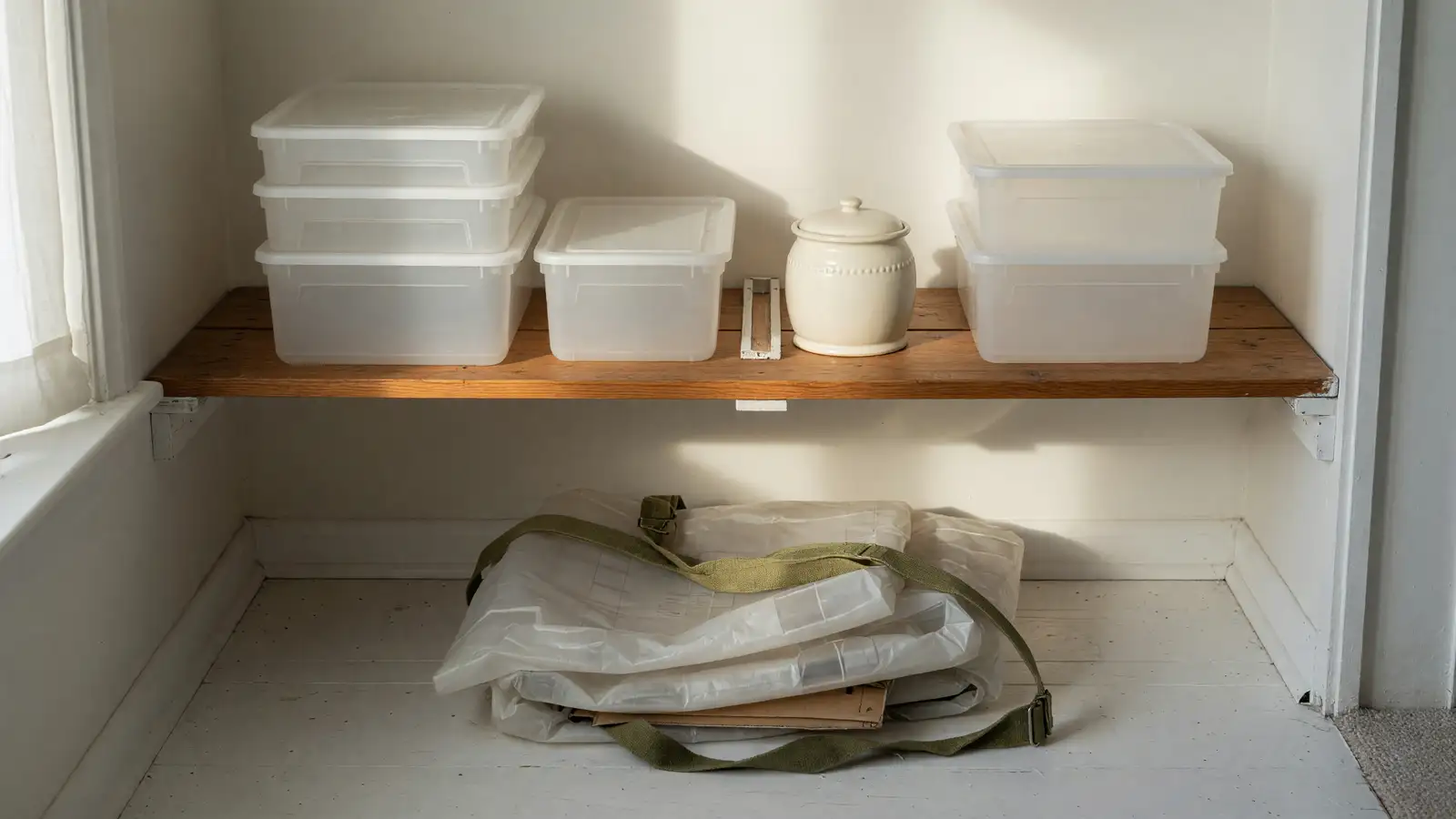
The Guardian headline is the whole argument. Professional organisers and declutterers they interviewed also talked about streamlining shoes and being strict with toiletries. Those are volume jobs. The container rule is a geometry job. You do not need a floor plan to see it. Put a round tub on a rectangular shelf and you have paid for four empty corners you will fill with junk because the corners now exist.
Declutter Hub’s organisers say the same thing in plainer English: they do not buy round containers because the containers take up a lot of space. That page is a podcast transcript, not this week’s news. Treat it as the reason the Guardian line is not a style preference. A lazy Susan in a corner cabinet can earn a circle. A round “decorative” bin on a closet shelf cannot. The shelf is a rectangle. The product should be too.
If you already own round canisters, do not throw them this week because a headline scolded you. Move them to a job that is actually round: oats on a lazy Susan, cotton rounds on a bathroom tray, a single utensil crock that sits in a dead corner of a counter. Do not line four of them on a 12-inch-deep shelf and call it a system. The air between them is not storage. It is the reason the shelf looks full when it is not.
We already put a load rating on an over-door pegboard that holds 11 pounds. Shape is the same kind of spec. If the object does not match the plane it sits on, the plane loses. People buy round because it photographs as “soft.” Soft is not a shelf rating.
Measure the shelf before you shop. Width, depth, height to the next shelf. Then look at the bin’s outside dimensions, not the gallons printed on the lid. Gallons are a volume brag. Outside width is whether two units sit flush or leave a gulley you will stuff with a bag of gift wrap.
A donation station is a bin with a date
The other half of the Guardian headline is not a mood board. A donation station is a container that is allowed to leave the house. It is not a second closet. If the bag or box lives in the hallway for six weeks, you built a clutter annex and named it charity.
Put one rectangular hamper or one open bin by the door you actually use. Not in the guest room. Not in the trunk “for later.” Clothes that failed the September swap, shoes you did not wear this season, the extra mug from the cupboard edit. When the bin is full, it goes to the drop-off the same week. If you do not have a drop-off on the calendar, you do not have a station. You have a pile with better branding.
This is the storage version of a deadline. The bin has a job only while it is in motion. Once it becomes furniture, it is competing with the holiday tubs Jones wants you to open this month, and it will win because it is closer to the door.
Keep the station ugly on purpose. A pretty lidded basket on a console is how donations become décor. An open box you can dump a sweater into on the way to the car is how the volume actually leaves. If you need a lid for pets or kids, use a lid you will still open with one hand. Childproof is for medicine, not for a pile of jeans.
Do not sort the donation bin into three sub-bins for different charities unless you already do that on a schedule. Sorting is how the station stalls. One destination. One trip. The Guardian paired the station with the round-container ban for a reason: both rules cut objects that pretend to help and then stay.
If your house already has a “maybe” box, that is not this. A maybe box is a delayed decision. A donation station is a decided object waiting for a car. Label it Donate, not Later.
Bags hold volume. They do not make a shelf
HuffPost’s Friday deal post is a collapsing bag with a strap, marked 50 percent off, sold on a quote that one bag held a third of a closet. Read that as a moving claim, not a closet plan. A third of a closet in one soft object is a compression trick. Compression is useful in a car and hostile on a shelf you have to live with.
The reviews in that post are honest about the job. Kait uses the bags to rotate winter and summer clothes and also for yarn. Kathleen Robinson stuffed a linen closet into them during a move, then kept using them in storage because they were huge and easy to carry. Another reviewer put 20 large, heavy silver trays in one bag; the material is opaque plastic you can sort of see through; the strap is a canvas-type band sewn around the whole bag so the weight does not rip a single handle off. That last reviewer said the bags were easier to transport than storage containers because they fit more into a small space.
Transport is the keyword. A bag wins when the object has to change buildings. It loses when the object has to sit in the same square footage for four months and you still need to find a sweater on a Tuesday. Soft sides slump. Stacking a second bag on the first is how you get a leaning tower and a broken zipper. If you cannot stack it, it is not a shelf product.
Use the bags the way the reviewers actually used them: off-season bulk that leaves the closet, a move, a wedding-venue run with trays. Then collapse them. The HuffPost pitch that they are “great organization items” is the sentence to ignore. Organization, in a closet, is retrieve-without-unpacking. A stuffed bag is a suitcase you live next to.
Do not vacuum-pack the sheets you change this week. We already said that about Costco gallons versus a linen pull. Same split: the collapsing bag is the 27-gallon’s cousin in fabric. It belongs with the comforter that comes out in December, not with the extra towels you grab on a wet Thursday.
If the bag is opaque enough that you only have “an idea” of what is inside, put a label on the strap the day you fill it. Winter / King comforter / yarn. An unlabeled bag in a hall closet is how you buy a second comforter in November.
Home Depot tubs are a footprint you can tape
Daily Meal’s Monday piece is not a closet article. Kendall Azevedo turned Home Depot plastic storage tubs into drawers under a Blackstone griddle: lids off, tubs as the drawer bodies, the stock shelf flipped and reinstalled, lids reused to hide the screws on top. Bobby Lewis notes that large plastic tubs do not have kitchen-drawer dimensions, so dividers may mean parchment paper as a template and plywood from the same store. Home Depot sells sheet metal and does not cut it.
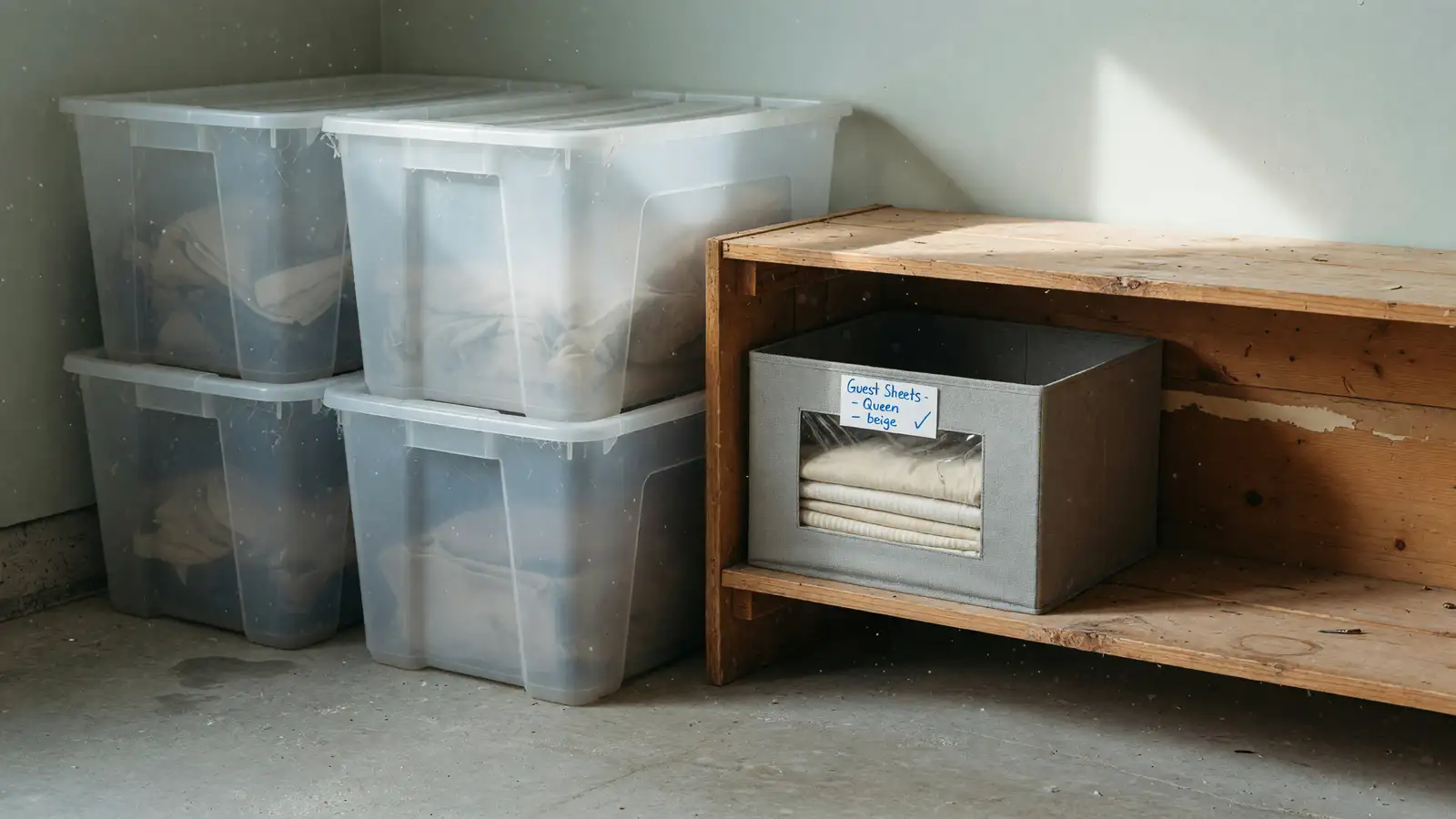
Steal the measurement, not the grill. Azevedo started with a tub that already had a width, a depth, and a lip that could slide. That is the opposite of buying a round canister because it was cute in the aisle. The tub was chosen because it matched a cavity. If your closet shelf is 14 inches deep, the tub’s outside depth has to be less than 14, including the lid ridge. If you cannot say that number out loud in the store, put the tub back.
The lid trick in that build is also a spec. They needed the lids as covers, not as stacking surfaces for a second life of bulk. A lid that exists so you can stack is a different product from a lid that exists so the cat stays out. Recessed lids that nest are how you get a wall of holiday bins without a pyramid. Domed lids are how you lose a third of the vertical space and then buy a second tower.
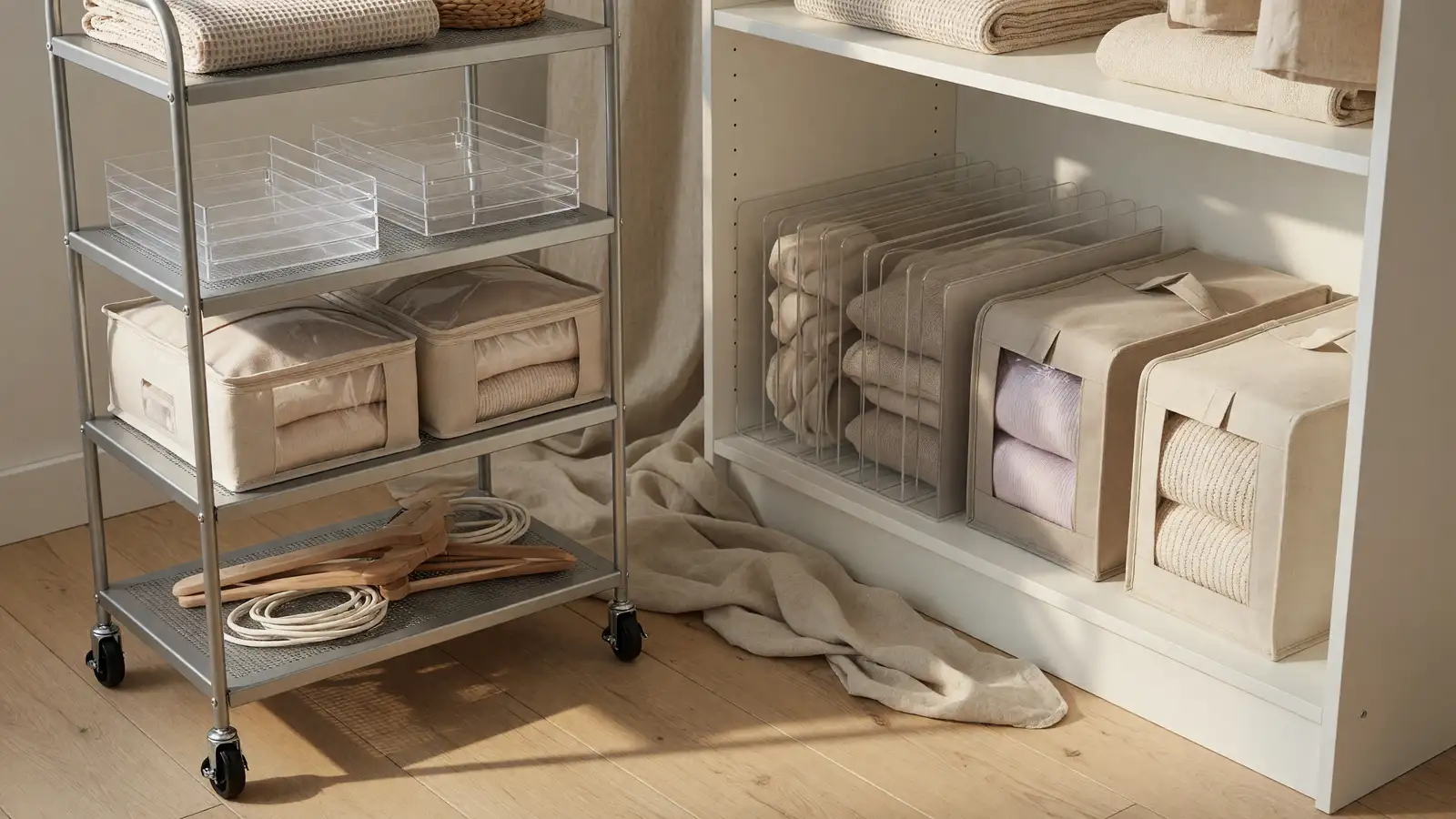
We already ran clear container zones as a whole-house system. This week is narrower: one cavity, one rectangle that fits it. The Blackstone drawers work because the couple accepted that an off-the-shelf kitchen organizer would not match a tub. Your linen closet is the same problem in a nicer room. If the “organizer” does not fit, you do not need a prettier organizer. You need a smaller tub or a different shelf.
Do not copy the exposed-screw aesthetic in a child’s closet. Copy the tape measure.
Holiday bins are inventory, not décor
Good Housekeeping’s September 19 roundup already showed up in yesterday’s keep-list piece as a calendar. The storage object inside it is the holiday bin. Shaniece Jones calls September a second New Year and wants two closets: the wardrobe you are swapping, and the holiday storage you are about to need. Her instruction is specific: check, edit, and organize the holiday bins now. Test the lights. Review the decorations. Take stock of entertaining pieces so you do not rebuy what you already own.
That is not decorating. That is a warehouse cycle. The bin you packed in January is a time capsule with a 50 percent chance of a dead string and a broken glass. Opening it in September is cheaper than a panic buy in November, and it is the only week the bin can still change shape. If last year’s round tin wasted a shelf, this is when you move those ornaments into a rectangle that actually stacks.
Jones’s closet swap is the other half of the same footprint. Sleeveless tops out, lightweight sweaters in. The clothes that fail the swap go to the donation station, not into a third plastic tower “for someday.” If you buy HuffPost bags this week to hide the clothes you will not donate, you used a moving product to avoid the Guardian’s first rule.
Test lights on the driveway or the porch, not in a dark attic with a bin on the stairs. A dead string is a trash bag, not a “maybe the other end works.” The entertaining platters you never used belong in the donation station, not in a second holiday tub you will forget again.
If you do not have holiday bins because you do not decorate, skip this section and do the closet swap anyway. The geometry does not care about tinsel. It cares whether the off-season pile is a stackable rectangle or a slumping bag in the hallway.
Match the SKU to the shelf, not the sale
BuzzFeed published 26 IKEA organization products on September 17. We already said CR’s 15 IKEA buys are a cart, not a home. This list is useful only as geometry with prices. A birch mini chest at $34.99 and up, in two sizes, is a desktop or a craft drawer, not a garage. A steel-mesh basket at $14.99 is a fruit bowl or a shallow catch-all. A $399.99 wardrobe is a piece of furniture; reviewer Jen put matching bins on the open, non-hanging side and treated the hanging side as coats. A $74.99 steel unit with mesh baskets is the one review that names the failure mode of cheap plastic: the drawers held more than expected and did not stick the way plastic bins did. A $12.99 cable organizer is a desk underside, not a closet.
The round bin never gets to be the hero on that list. The wardrobe works because one side is a rod and the other side is rectangles. The steel drawers work because they are rectangles in a rectangle. The mini chest works because it is a box on a desk. If you add a round canister to any of those, you are the person who bought a system and then punched a hole in it.
The HuffPost bag sale, the Home Depot tub, the IKEA wardrobe, and the Guardian ban are not a shopping list. They are a filter. Ask, in this order: Does it have to leave the building this month? Bag. Does it have to sit on a shelf until January? Rectangle with a recessed lid, sized to the shelf, not to a gallon number. Is it waiting for a drop-off? Open donation bin by the real door, emptied this week. Is it round? Only if the home for it is already a circle.
If you cannot answer those in the aisle, you are buying a photograph. Put it back. The shelf will still be a rectangle when you get home.