Fox News asked a two-time U.S. barista champion about the mold posts this week. Heather Perry, who runs Klatch Coffee in California, told Deirdre Bardolf the scare is doing the wrong job. Cleanliness changes flavor. It is not, in her view, a home biohazard. “Coffee is totally fine to be type B about,” she said.
That is a cleaning article, not a wellness panic. The piece that actually needs a Saturday is the insulated carafe you cannot see into, the scale on the heating path, and the oily film in the grinder. Tom’s Guide published a Breville descale walkthrough the same week because the CLEAN/DESCALE light does not care about your TikTok. We already treated hidden appliance jobs as fall work in the dryer-vent piece. This one lives next to the kettle.
Mold content is not a work order
Perry’s first correction is blunt. “You do not at all need to be worried at home about mold and bacteria.” She put it incredibly low on the list of coffee-equipment worries. Viral clips of fuzzy reservoirs exist because a wet tank photographs well. A stained thermos pot does not. The stained pot is still the thing in your cup.
Beans sold as “tested for mold” got the same shrug. “That is 100% a marketing thing,” she told Fox News Digital. If a bag needs a fear label to move, that is merchandising. It is not a reason to bleach a drip machine on a Tuesday. Flavor is the metric she will defend. Safety theater is not.
This is the same pattern as scented-cleaner content that treats smell as proof of sanitation. Smell is a particle. A clean carafe is a surface. If your machine smells like old diner coffee, you have oils. If it smells like a basement, you left water sitting and you should empty the tank. Neither case is a reason to throw the machine out. Empty, wash, dry.
Perry’s line that equipment cleanliness has “way more importance when it comes to the flavor” than as a “true safety issue” is the frame for the rest of this page. You are not failing a health inspection. You are brewing through last month’s film. That is a Saturday job with a bottle brush, not a medical event.
If you have a household that panics at any damp gasket, put the phone down and look at the pot. The posts are optimized for disgust. Your mouth is optimized for stale. Stale is the ticket.
The pot, not the tank
“Once that’s in your pot, you’re gonna taste that in your cups,” Perry said. The reservoir is water. The carafe is where the brew sits, cools, and paints the walls with oils. Insulated “thermos pots” are the worst version of this because you cannot see the ring. Glass at least shows the brown.
Her instruction is not exotic. Scrub the vessel you drink from. Do it more often than you descale. A clear glass carafe can go in a sink with hot water and a brush. An opaque thermal carafe needs a long-handle brush and a look with a flashlight. If you only rinse, you are seasoning the next pot with the last one.
This is why “I cleaned the tank” still tastes like office coffee. The tank was never the flavor chamber. Mineral scale in the tank slows the machine. Oils in the pot rewrite the cup. Do both, in that order of how often: pot weekly, path when the faucet tells you.
If you use a single-serve machine, the analog is the drip tray and the pod well, not a carafe. Andrew Pautler told Fox in the spring that a used Keurig or Nespresso pod left overnight makes a warm, damp box. Bacterial growth, stale flavors, residue. Eject the pod once it is not going to burn you. Do not run a second breakfast through yesterday’s puck. Perry’s week is about drip and espresso gear. Pautler’s leftover pod is the same class of job: the wet part you stop seeing.
A thermal carafe also hides volume. People brew a full pot “for later” and then microwave a mug at 11. That is how stains set. Brew what you will drink in an hour, or move leftover coffee into a clean bottle in the fridge for iced, not back through the same unwashed insert. The machine is not a holding tank.
Hard water is a faucet problem that moved
Perry’s visual cue is the one you already have. “Whatever you see in your sink faucets, your showerheads — that’s what’s happening with your coffee brewer.” White crust on a tap is the same mineral load going through a heating element. When the showerhead needs a bag of vinegar, the brewer is not magically exempt.
She wants better water more than she wants a heroic descale schedule. Filtered at home. Bottled if the tap is brutal. Not distilled, not reverse-osmosis. Coffee is “98% water,” she said, and flavor sticks to minerals. Strip the minerals and the cup goes thin. That is a taste argument, not a plumbing flex.
Tom’s Guide’s generic tap-water note in the same week is more mechanical: if you are on tap, descale about every 40 brew cycles. That number is a reminder, not a laboratory interval. Households on well water or a cheap kettle that furs in a month should ignore 40 and watch the faucet. Households on already-soft municipal water can go longer. The showerhead still wins as a clock.
This is the same logic as swapping an HVAC filter when the first real frost is late, which we already wrote as a filter job, not a calendar. Appliances do not honor October 1. They honor load. Coffee load is cups plus hardness.
If you refuse to buy bottled water, a pitcher filter is enough for the tank. Do not fill from the hot side of the tap. Hot-side lines are a separate crust. Cold, filtered, into a tank you empty if you will not brew tomorrow. Standing water is how the internet gets its mold thumbnail. Emptying the tank is free.
Scale that you can see in the tank is already late. Scale you cannot see is why the CLEAN/DESCALE light exists on machines that bother to have one. If your machine has no light, time it off the faucet, not off guilt.
Breville’s light is a procedure, vinegar is a tank soak
Tom’s Guide split Breville into models because the buttons are not the same. Barista Express: when CLEAN/DESCALE lights, dissolve one Breville descaling powder sachet in a litre of water, fill the tank, remove the water filter first. Hold 2-CUP, then POWER, to enter the mode. 1-CUP runs the coffee path. Steam dial right for steam, left for hot water. About half a litre should remain; repeat; rinse the tank; fill to max with fresh water and run the same paths again; POWER to exit.
Bambino Plus tells you with 1 CUP, STEAM, and 2 CUP flashing alternately for 15 seconds. Empty the drip tray. Fill to the DESCALE line and add the agent. Precision Brewer and One Touch have their own pages in the same guide. The point of copying the Express steps here is not to replace the manual. It is to show that “run vinegar through it” is not what that machine is asking for when the light is on.
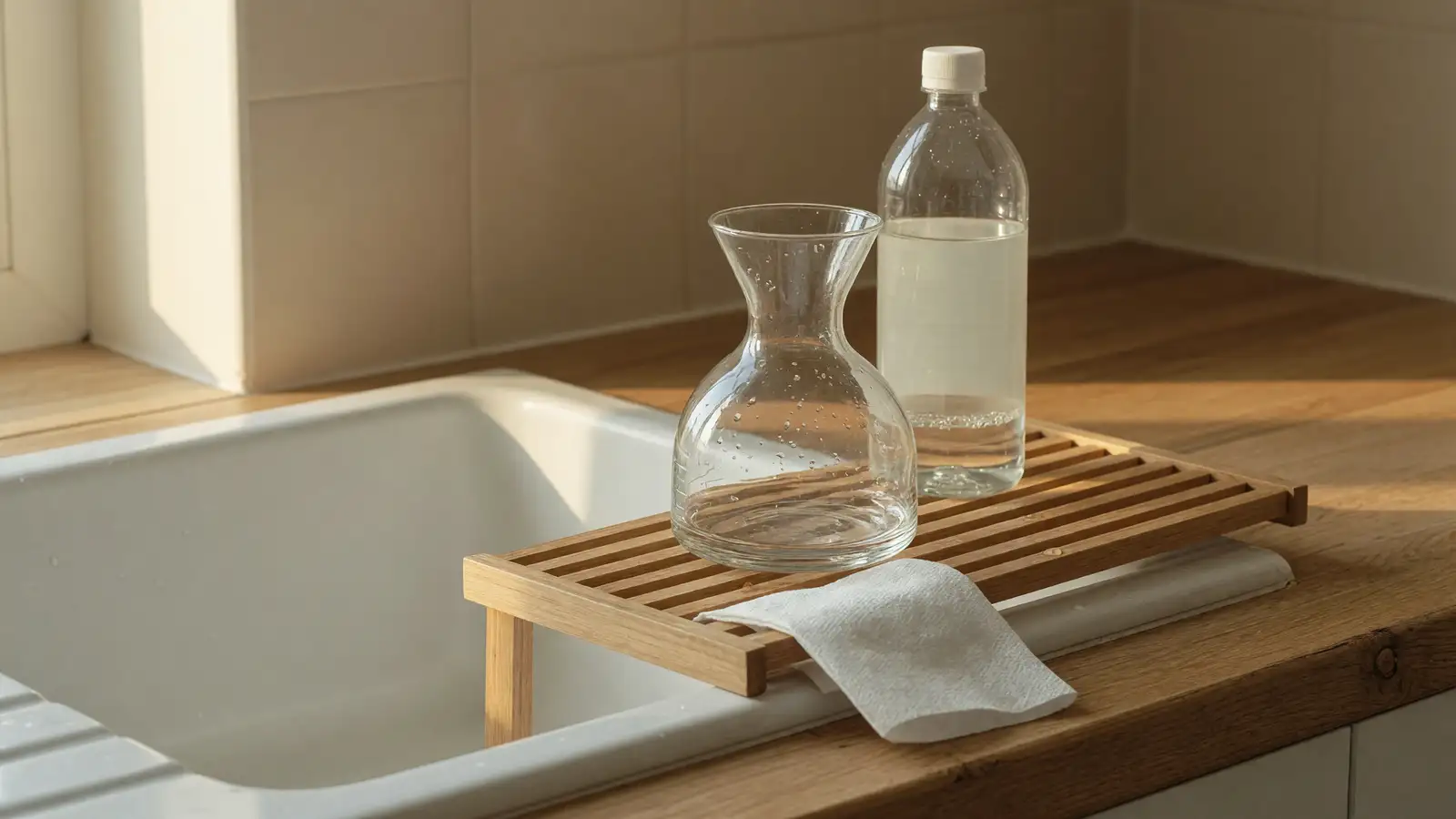
Vinegar still has a job on dumb tanks. Tom’s Guide’s generic reservoir soak is undiluted white household vinegar overnight, dump, rinse by filling halfway twice. That is a plastic tank, not a branded espresso boiler with a powder sachet and a filter you were told to pull. If you vinegar a Barista Express because a relative did it to a Mr. Coffee, you skip the steam path and you leave the water filter in a acid bath. Read the light. Use the sachet the light was calibrated for.
Compatible descale kits were listed around $29 in that article, with the usual affiliate asterisk. The kit is cheaper than a service call and cheaper than deciding the machine “just died” when it is a blocked path. Keep one sachet in the same cabinet as dishwasher salt. If you do not own Breville, keep vinegar and a funnel. Do not mix the two religions on the same Saturday.
After a descale, brew and dump one blank tank of water even if the manual already made you rinse. Your first cup after scale-out should not taste like the kit. If it does, you under-rinsed. That is not a personality. That is leftover citric or sulfamic acid.
Grinders and leftover wet
Perry does not want a weekly teardown of a burr grinder. She wants a dry paper towel on the hopper and the grounds chute when you see film. “Get the coffee oils off of it.” The tell is smell. Fresh coffee smell is fine. Old coffee smell is the oils going rancid on plastic. “If you start to see coffee oils forming, the longer they stay, the harder they are to get off.”
Do this with the grinder unplugged. Do not wash a burr set like a French press unless the manufacturer said water is legal. Water plus grounds plus an electric motor is how you buy a new grinder. Dry wipe, then a stiff brush on the chute. If you need more, rice or dedicated grinder-cleaning pellets, then dump the next shot because it will taste like the cleaner.
Single-serve users, again: Pautler’s leftover pod is the wet equivalent of Perry’s oil film. Heat plus damp plus organic residue. Pull the pod. Wipe the needle area if your model lets you without a screw ritual. Empty the drip tray before it becomes a science fair. None of that is “deep clean.” It is not leaving wet food in a warm box.
Fridge storage of beans got a no. Moisture and leftover onions. Perry would rather you use the freezer than the fridge, and she would rather you leave the open bag out if you will finish it in a month. A month is a consumption rate, not a shrine. If a 12-ounce bag lasts a quarter, buy smaller bags. The freezer is for the backup, sealed, not for the daily scoop with condensation every morning.
The closed-house fall routine already assumed windows stay shut and indoor air gets stale. Coffee gear is a small, hot, wet appliance in that same house. It does not get a pass because breakfast is sacred.
A weekend coffee-kit reset that fits a sink
Do this in the order that prevents you from “cleaning” the pretty parts and skipping the flavor parts.
First, dump the tank. Wash the carafe or thermal insert with hot water and a brush until a paper towel comes out without brown. If it is thermal and you cannot see, flashlight. Second, wipe the grinder hopper and chute dry. Third, look at the faucet. If the faucet is crusty, descale on the schedule your machine actually documents — powder and button dance for Breville, vinegar soak for a dumb reservoir. Fourth, if there is a pod still in a single-serve well, that was the whole problem and you can stop performing.
Dry the tank lid open for an hour. Closed wet lids are how the mold thumbnail gets shot. Then fill only what you will brew. Perry’s “type B” is permission to skip the panic. It is not permission to never wash the pot.
If you share the machine, put the brush next to it. A ritual that lives in a hall closet will lose to a 6 a.m. timer. The dating-show energy some brands put on storage does not apply here. Nobody is judging your hopper on television. Your tongue is.
The mold posts will keep coming because disgust is cheap to film. Perry’s week is useful because she named the part that actually hits the mug. Scrub the vessel. Time the scale off the tap. Wipe the oils before they varnish. Eject the pod. That is a cleaning routine. The reservoir was a decoy.