Something quiet is happening in the American housing market, and it tells a story that goes well beyond real estate. According to new data from home builders and analysts, move-up buyers — the demographic that traditionally traded smaller homes for larger ones — are now prioritizing better space over more of it. They want well-designed kitchens, flexible rooms that evolve with family needs, and outdoor areas that extend daily life, not just additional square footage to heat and clean.
“Buyers are becoming more intentional about how they evaluate value in a home,” Angela Nuessle, a national vice president at a major home builder, told Builder Magazine last week. “They’re placing greater value on homes that support the way they live.”
This shift isn’t happening in isolation. Across the culture, a parallel conversation is unfolding about what makes a life feel full. Ian Bogost’s new Atlantic newsletter series, “Ordinary Extraordinary,” launched this month with a premise that could double as a minimalist manifesto: “What if your life could be richer and more delightful without your having to change anything you’re currently doing?”
Bogost isn’t writing about real estate. He’s writing about attention, about the possibility that the texture of daily life — the sound of rain, the way light moves through a window, the rhythm of a familiar walk — contains more richness than we typically grant it. But the resonance with what’s happening in the housing market is hard to miss. Both stories point toward the same uncomfortable truth: the instinct to solve dissatisfaction by acquiring more, whether square footage or possessions or experiences, has a terrible track record.
The Upgrade Treadmill
The standard American housing trajectory has been remarkably consistent for decades. Starter home becomes family home becomes forever home, each move bringing more rooms, more storage, more space to fill. The logic was self-evident: more is better. A bigger kitchen is a better kitchen. A walk-in closet beats a reach-in. A three-car garage signals arrival.
What the new data suggests is that this logic is cracking. Buyers who could afford more square footage are choosing instead to optimize the square footage they have. They’re trading the formal dining room they use twice a year for a kitchen island where the family actually gathers. They’re converting bonus rooms into dual-purpose spaces that serve as both home office and guest quarters. The question has shifted from “how much can we get” to “what will we actually use.”
This is, at its core, a minimalist insight dressed in real estate language. The organizing principle isn’t deprivation — it’s intention. You don’t refuse the bigger house because you’re making a sacrifice. You refuse it because the smaller, better-designed one makes your daily life better.
Applying the Principle Beyond Housing
The “better, not more” framework applies far beyond square footage. It works just as well for wardrobes, kitchen gadgets, kids’ toys, and the endless stream of stuff that accumulates in American homes by default rather than decision.
Take the kitchen. Most well-stocked kitchens contain at least a dozen tools that get used once a year or less — the fondue pot, the specialized avocado slicer, the panini press that seemed essential when you bought it. The space these items occupy isn’t free. Neither is the mental overhead of remembering you own them, the guilt of not using them, or the friction they add to finding the tools you actually reach for every day.
The alternative isn’t a bare kitchen with one pot and a wooden spoon. It’s a kitchen where everything earns its place through regular use. Where the counter is clear because the appliances that live there — the coffee maker, the toaster, the stand mixer — are the ones that get powered on at least once a week. The result isn’t asceticism. It’s a kitchen that’s genuinely easier to cook in.
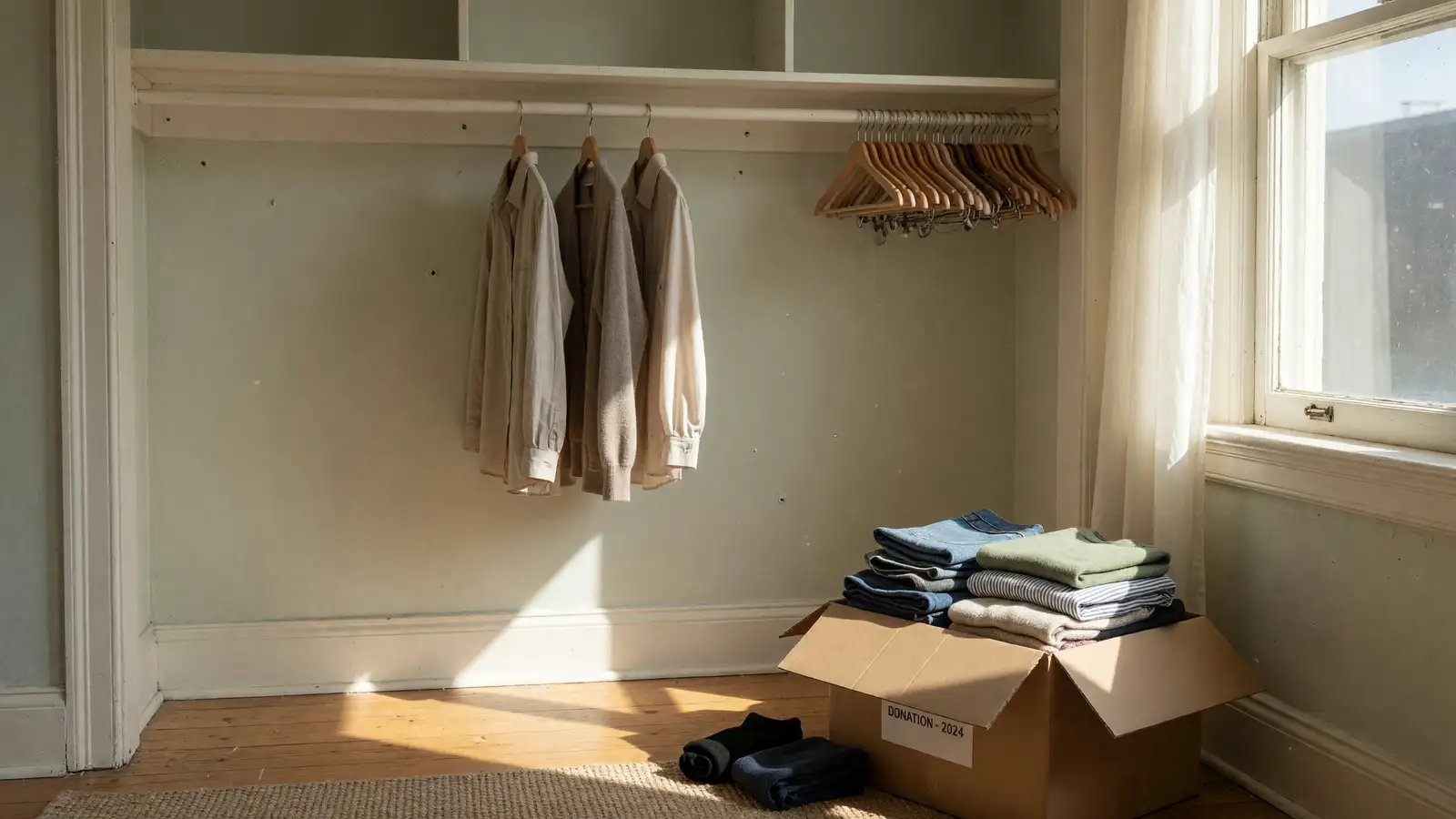
The same logic reshapes a closet. Most people wear 20% of their clothes 80% of the time. The other 80% of the closet is hope, obligation, and sunk cost. A better closet isn’t necessarily a smaller one. It’s one where everything hanging in it is something you’d actually wear tomorrow without hesitation.
The Deeper Shift
There’s something more interesting happening here than a design trend or a decluttering fad. When Bogost asks readers to find richness in their existing lives, and home buyers demonstrate with their wallets that they prefer quality to quantity, and professional organizers keep repeating that the goal isn’t less stuff but the right stuff — these aren’t separate conversations. They’re the same conversation happening in different languages.
What they share is a rejection of the idea that forward motion requires more. That a better life looks like a bigger life. That satisfaction is something you acquire rather than something you notice.
The practical takeaway is straightforward enough: before your next purchase, your next upgrade, your next accumulation of things, ask yourself whether you’re solving a real problem or chasing a feeling that stuff has never successfully delivered. But the philosophical one matters more. The richest lives might be the ones where you stop looking for the next thing and start paying attention to what’s already right in front of you. The Atlantic is betting an entire eight-week newsletter series on that idea. The housing market, quietly and without fanfare, appears to be betting on it too.